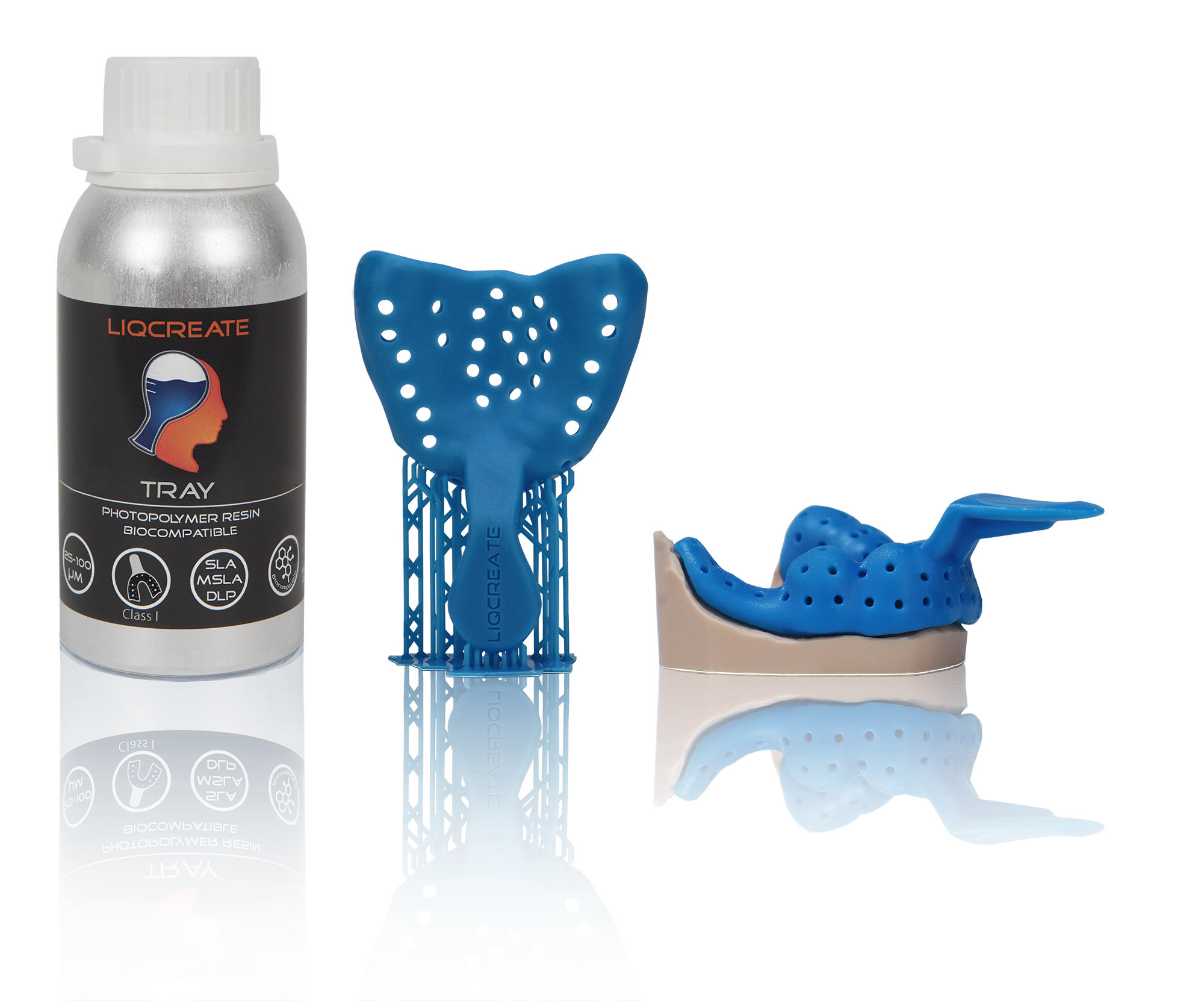
Netherlands-based independent 3D printing resin manufacturer Liqcreate has introduced Liqcreate Tray, a CE Class 1 certified biocompatible resin designed for 3D printing custom dental impression trays.
The material was developed in collaboration with dental laboratories and clinical partners and is formulated to work across a broad range of open-platform resin printers.
“We heard consistently from labs that they wanted a tray material that just worked across the printers they already had, without compromising on rigidity or clinical safety. That feedback shaped a lot of what went into this formulation,” said Ruben Soors d’Ancona, Strategic Business Developer at Liqcreate.
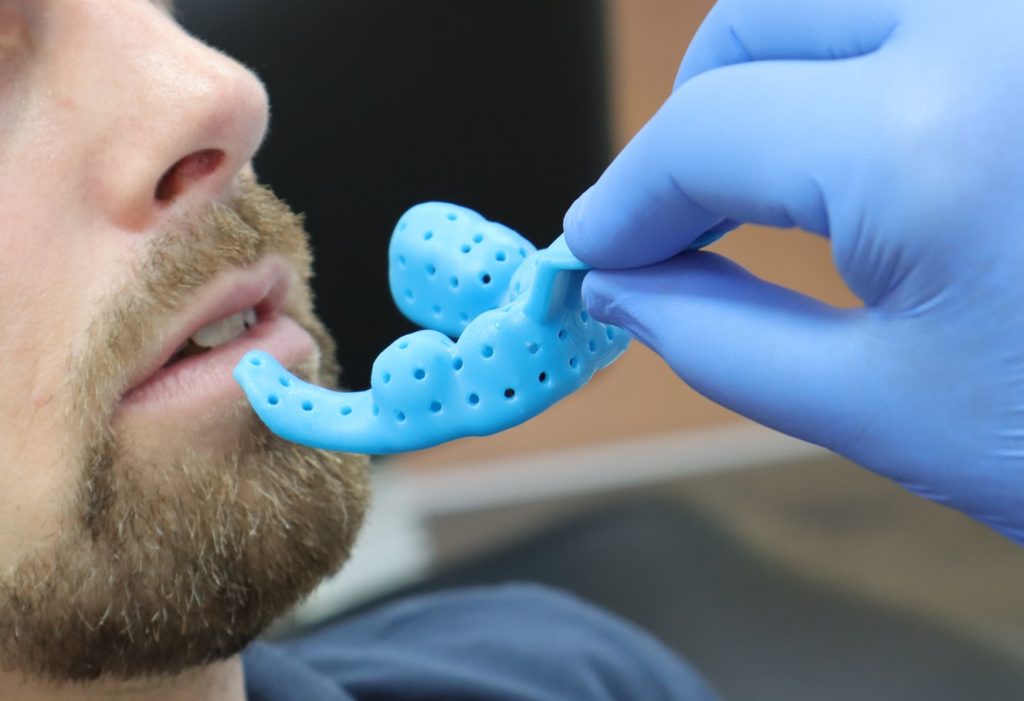
The release comes at a point where most of the dental lab workflow has already gone digital. Intraoral scanners, CAD software, and design tools have transformed the production chain, but custom impression trays remain a stubborn holdout. Many labs are still mixing acrylic by hand, waiting for it to cure, and trimming to fit.
It works, but it introduces variability and sits awkwardly alongside everything else that moved to CAD/CAM years ago. The 3D printers capable of handling tray fabrication have been around for a while. What has been harder to find is a resin that prints reliably, holds up mechanically during impression taking, is officially class 1 certified with an attractive price per kg, and does not lock a lab into a single manufacturer’s hardware ecosystem.
Compatible With Multiple 3D Printers
That hardware flexibility is where Liqcreate Tray makes its strongest case. The resin is compatible with DLP, MSLA, and laser-based 3D printers operating at 385-405 nm. This is a range that covers entry-level machines from Anycubic, Elegoo, Uniformation, and Creality as well as professional platforms including Asiga, Prusa Research, Raise3D, and Phrozen. For labs and clinics already running any of these systems, adoption does not require new hardware.
The company says it is continuously validating additional 3D printer profiles and publishing updated settings on its website as new systems are qualified, which in practice matters more than it sounds. A resin is only as useful as the profile tuned for a specific machine, and validated starting points save real time.

Once the printing is done, the post-processing is equally straightforward. Parts are washed twice in isopropyl alcohol (IPA) using an ultrasonic cleaner or a dedicated wash station, left for 30 minutes, then post-cured for 15 minutes in the Elegoo Mercury X.
According to the manufacturer, the resulting trays exhibit high dimensional accuracy and a rigid structure that supports stable impression taking across implant cases, dentures, crowns, bridges, and other restorative treatments. That covers the core of what most labs are fabricating trays for on a daily basis.
On the clinical safety side, the trays can be disinfected with commonly used disinfectants and, where cases demand it, steam sterilized at 121°C or 134°C in validated autoclave programs.
That autoclave compatibility is not a given with every tray resin on the market, and for implant work or anything requiring a sterile field, it is a practical differentiator. The formulation is also designed to be economical enough for high-volume production as well as daily chairside use.
Liqcreate Tray is well suited for volume production, as users can print trays at a 200-micron layer height, significantly reducing print times and enabling more trays to be produced in a single day.

Built for Clinical Demands
Liqcreate Tray is the latest addition to a growing dental portfolio from the company, building on the earlier release of Liqcreate Separation Model, which tackled a different problem altogether. That resin prevents polymethyl methacrylate (PMMA) acrylics from bonding to 3D printed models during procedures like denture repairs, reline work, and orthodontic appliance fabrication using the salt and pepper method.
The two products serve different functions, but together they suggest Liqcreate is systematically filling gaps in the open-material dental workflow as opposed to banking on a single product.
That open-material focus is itself a deliberate positioning choice. As an independent resin producer, Liqcreate operates without the vertical integration of companies that sell both printers and materials. Labs working on open platforms gain flexibility in hardware choice and avoid proprietary material markups, but they also take on the responsibility of managing compatibility themselves.
For operations already committed to open ecosystems, that calculation is familiar. The company also offers private-label and custom formulation partnerships for those looking for tailored material solutions.
Liqcreate Tray is available now in 1 kg units through the Liqcreate online store or by contacting the company at [email protected].
3D Printing Industry is inviting speakers for its 2026 Additive Manufacturing Applications (AMA) series, covering Energy, Healthcare, Automotive and Mobility, Aerospace, Space and Defense, and Software. Each online event focuses on real production deployments, qualification, and supply chain integration. Practitioners interested in contributing can complete the call for speakers form here.
To stay up to date with the latest 3D printing news, don’t forget to subscribe to the 3D Printing Industry newsletter or follow us on LinkedIn.
Explore the full Future of 3D Printing and Executive Survey series from 3D Printing Industry, featuring perspectives from CEOs, engineers, and industry leaders on the industrialization of additive manufacturing, 3D printing industry trends 2026, qualification, supply chains, and additive manufacturing industry analysis.
Featured image shows Liqcreate Tray resin with a printed tray on supports and a finished tray seated on a dental model. Image via Liqcreate.