

Washington State House Bill 2321 has sparked debate by proposing new technical restrictions on 3D printers to stop them from producing a firearm or illegal firearm parts. Backed by multiple House sponsors, the proposal is still under committee review, making a full House vote uncertain. The bill reflects growing legislative attention on the role of privately owned 3D printers in the broader discussion around homemade firearms.
Targeting “Ghost Guns” Through Design File Screening
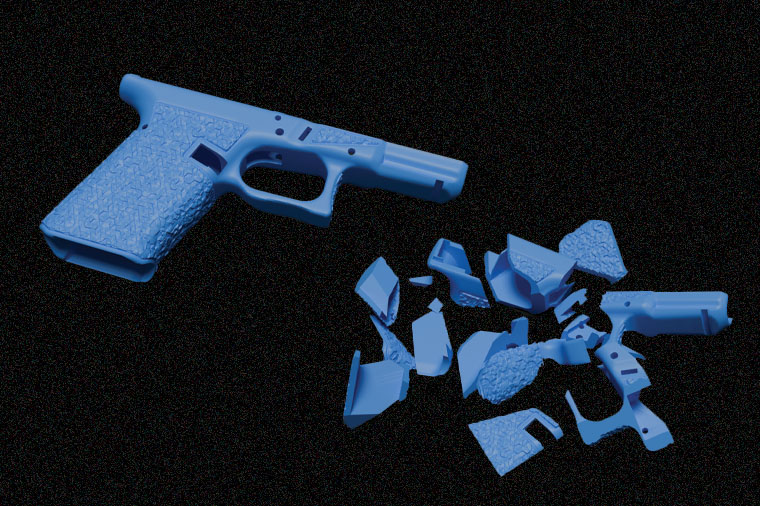
In the U.S., “ghost guns” are homemade firearms built from kits, spare parts, or DIY components. While barrels are usually metal, other parts can be 3D printed in plastic. HB 2321 targets the receiver and frame, the legally regulated components, aiming to block their production through additive or subtractive methods.
The bill would require a firearm-detection algorithm to approve design files before they could be printed. Under the proposal, all 3D printers sold or transferred within the state would need to include this blocking capability, alongside a mandatory “preprint authentication” process. The state attorney general would also be tasked with maintaining a database of firearm-related designs deemed illegal for users without the appropriate licenses.

Practical and Legal Challenges
Critics argue that implementing such scanning and blocking systems would be difficult to enforce and relatively easy to bypass, raising questions about effectiveness and user privacy. While recent legal developments, including Bondi v. VanDerStok, acknowledge that advances in 3D printing merit legislative scrutiny, opponents note that most “ghost guns” still originate from kits and conventional supply chains rather than from fully 3D printed designs.
In addition, 3D printed firearm designs—such as complex bullpup-style weapons—often require extensive manual assembly, metal components, and significant time investment. Detecting firearm parts across each of these steps would likely prove impractical, reinforcing skepticism that HB 2321 will advance to a vote, let alone become law.
The Rise of 3D Printed Guns
Concerns over 3D printed firearms have intensified nationwide. These weapons appeal to extremists and DIY enthusiasts alike, as they allow individuals to bypass conventional regulations and produce functional firearms at home. In an interview with Dr. Yannick Veilleux‑Lepage, a terrorism and emerging-technology researcher, noted that active online communities provide detailed instructions and guidance, lowering barriers to production even in regions with strict gun laws.
High-profile examples illustrate the challenges regulators face. The Urutau, a fully 3D printable firearm designed in Brazil, can reportedly be produced in under a week using widely available printers, and its step-by-step guide includes operational security tips to help users evade detection. Meanwhile, lawsuits over “Glock switches”—printable devices that convert semi-automatic pistols into fully automatic—demonstrate the legal and enforcement complications surrounding DIY firearms. Even when courts intervene, as in the case requiring Glock to redesign certain pistols, critics argue that broader societal factors, rather than manufacturing restrictions alone, largely drive gun violence.

In response, states are exploring new ways to curb 3D printed guns. New York, for example, has proposed legislation that would require 3D printer manufacturers to block the creation of guns and gun components. The bill mandates printer-level safeguards, restricts access to digital design files without authorization, and requires law enforcement to log recovered 3D printed firearms. Additional measures include redesigning commercial pistols to prevent easy conversion to fully automatic fire.
The 3D Printing Industry Awards are back. Make your nominations now.
Do you operate a 3D printing start-up? Reach readers, potential investors, and customers with the 3D Printing Industry Start-up of Year competition.
To stay up to date with the latest 3D printing news, don’t forget to subscribe to the 3D Printing Industry newsletter or follow us on Linkedin.
Featured image shows An example of a broken ghost gun. Image via Raviv lab.