
Large-format 3D printer manufacturer Modix has announced Generation 5, a new electronics platform rolling out across its BIG series of large-format 3D printers.
The upgrade moves Modix machines to the Duet 3 control platform with CANBUS distributed electronics, providing capacity for more than 20 axes and drivers. According to the company, the additional control capacity provides the foundation for three new technologies: automatic tool changing, pellet extrusion and 45-degree printing.
Generation 5 is already being supplied to customers, with Modix stating that machines ordered through the summer are shipping with the new platform. The company plans to demonstrate the technologies at Formnext 2026.
Duet 3 platform expands machine control
At the center of Generation 5 is the move to Duet 3 electronics combined with CANBUS distributed control. Modix is using the additional control capacity to support more complex machine configurations. The architecture provides headroom for more than 20 axes and drivers, allowing additional tools and motion systems to be integrated into the BIG platform.
One of the first technologies enabled by the new system is Bondtech’s INDX automatic tool-changing platform. Automatic tool changing allows a printer to switch between different extrusion tools during a single build. On Modix systems, the company says this will enable multiple materials and colors to be combined within the same component on printers measuring one meter and above.
Modix is positioning the integration as a way of bringing a capability increasingly found on smaller desktop systems into large-format material extrusion. The announcement does not specify how many tools can currently be used, tool-change times or the range of material combinations supported.
Pellet extrusion and 45-degree printing expand BIG series capabilities
Generation 5 will also support a compact pellet extruder developed for the BIG series. Modix says the setup is intended to combine the throughput of pellet extrusion with the finer detail available from filament on the same machine.
This could allow users to select between extrusion approaches depending on the geometry or requirements of a part rather than relying on separate pellet and filament systems.
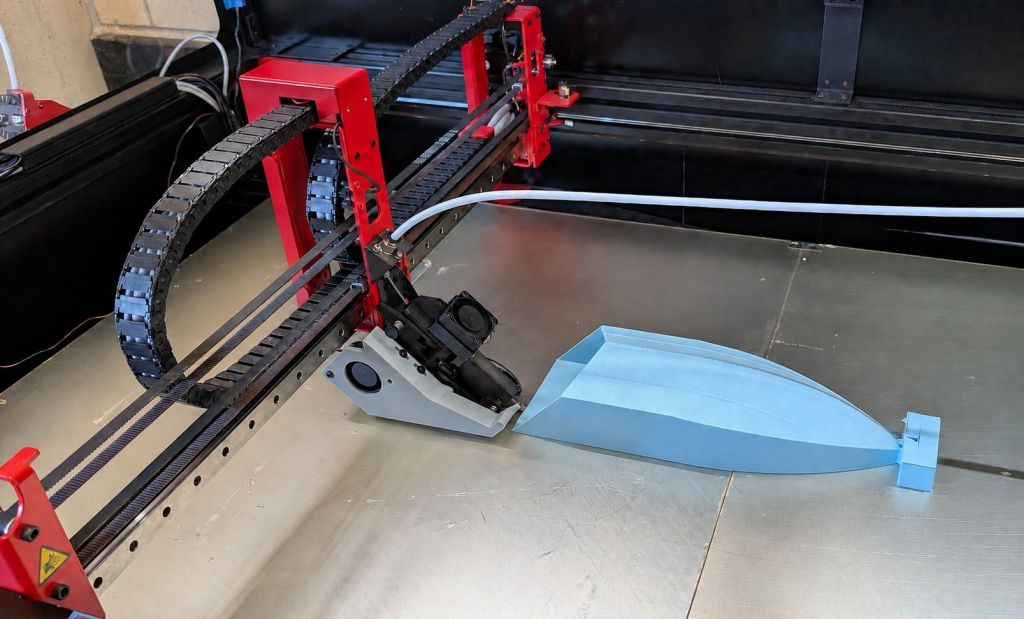
A third capability introduced alongside Generation 5 is 45-degree printing. The approach is already associated with belt-style 3D printers, where components are deposited at an angle relative to the build surface, and Modix is now adapting the concept for its large Cartesian machines.
Printing walls at an angle can produce geometries that would otherwise require substantial internal support structures. For large hollow parts, this can reduce material consumption and the amount of post-processing required.
The potential benefit becomes more significant as part size increases, since internal supports on meter-scale components can consume considerable amounts of material and become difficult to access or remove.
Upgrading the existing Modix installed base
A notable part of the Generation 5 rollout is that the new technologies are not limited to newly purchased printers.
Modix says automatic tool changing, pellet extrusion and 45-degree printing will be available as upgrades for machines already owned by customers. This allows the company to introduce new capabilities across its existing BIG series installed base rather than requiring users to replace complete systems.
That upgrade path also makes the electronics architecture important beyond the immediate Generation 5 launch. By increasing the number of axes and drivers that can be controlled, Modix is creating additional capacity for future tooling and machine configurations.
Modix will showcase Generation 5 and the associated technologies at Formnext 2026 in Hall 12.1.
Throughput remains a constraint as extrusion systems move to larger build volumes.
In January 2026, Subaru of America reported that print duration continued to limit production of large 3D printed tooling on its Stratasys F770. Testing a higher-flow T25 print head produced speed increases of 1.86x to 2.27x across tested geometries, including a 1.96x improvement on a 36-inch tool. Pellet extrusion can increase material flow, but also introduces design tradeoffs.
Omnific 3D, for example, optimized its BGM-1000 for filament and said it avoided a pellet extruder because the additional moving mass would reduce machine speed. Modix’s compact pellet system targets the same balance between throughput and motion performance, although the company has not yet disclosed extrusion rates or comparative print-speed data.
Material flexibility presents a separate constraint. Bondtech and Prusa Research introduced INDX for the CORE One at Formnext 2025 as an eight-material system using one active Smart Toolhead and multiple lightweight passive tools, reducing the need for filament swaps and purge material between changes.
Modix is now adapting the same tool-changing architecture to printers measuring one meter and above, extending the approach from a compact desktop platform into large-format material extrusion.
3D Printing Industry is inviting speakers for its 2026 Additive Manufacturing Applications (AMA) series, covering Energy, Healthcare, Automotive and Mobility, Aerospace, Space and Defense, and Software. Each online event focuses on real production deployments, qualification, and supply chain integration. Practitioners interested in contributing can complete the call for speakers form here.
To stay up to date with the latest 3D printing news, don’t forget to subscribe to the 3D Printing Industry newsletter or follow us on LinkedIn.
Explore the full Future of 3D Printing and Executive Survey series from 3D Printing Industry, featuring perspectives from CEOs, engineers, and industry leaders on the industrialization of additive manufacturing, 3D printing industry trends 2026, qualification, supply chains, and additive manufacturing industry analysis.
Featured image shows Modix Generation 5 45-degree printing. Photo via Modix.