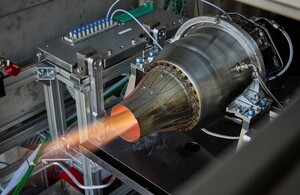
The UK Ministry of Defence (MOD) and manufacturing start-up Alloyed have taken a new turbojet engine from initial concept to a completed flight in under seven months, as part of a co-development program aimed at building a domestic, rapidly scalable propulsion capability for British defense systems. The program has already produced a family of engines spanning a wide thrust range, with two variants now in flight testing or production.
The effort is led by MOD’s Strategic Capabilities Office and combines government investment with matched funding from Alloyed, a co-investment structure intended to speed up development while strengthening the UK’s defense industrial base. More than 60 engineering and advanced manufacturing jobs have been created in Britain through the program so far, with a further 45 expected over the next year as production scales up. The work also supports a supply chain of more than 40 UK suppliers, most of them small and medium-sized enterprises.
From drawing board to flight test in months
The engines were designed, built and tested entirely in the UK using what the MOD describes as digital design and manufacturing, an approach the program credits with compressing development timelines that would traditionally take years down to a matter of months. The family spans a thrust range of 30N to 2000N, covering applications from small drones up to larger aircraft.
Two engines have already moved into production: a 300N-class engine has completed flight testing and entered serial production, while a larger 1100N-class engine went from initial concept to flight-ready status in under seven months.
Michael Holmes, Chief Executive Officer of Alloyed, tied the pace of development to the company’s underlying materials and manufacturing expertise. “Working alongside the Ministry of Defence has enabled Alloyed to bring to bear its world-leading metals technologies to mature and demonstrate advanced propulsion systems at remarkable pace while building a lasting capability in the UK,” he said.
The “digital design and manufacturing” language in the MOD’s announcement, and Holmes’s reference to Alloyed’s “world-leading metals technologies,” point to metal 3D printing. Alloyed designs custom metal alloys and then 3D prints them from powdered metal using industrial 3D printing machines, which is how the turbojet components in this program were most likely produced, rather than machined from solid metal stock.
A sovereign, modular propulsion base
Beyond the individual engines, the program has built a UK-based digital design and modeling process intended to let future propulsion systems and engine variants move from concept through assessment into production in months. The modular architecture behind the engines is also designed to accommodate future upgrades without requiring extensive redesign work, giving the MOD flexibility to adapt the engines to a broad range of operational requirements as they emerge.
Luke Pollard MP, Minister for Defence Readiness and Industry, framed the program’s speed as a direct response to current strategic pressures. “The threats we face demand the ability to produce cutting-edge technology on demand and at scale – this programme delivers that, combining sovereign manufacturing, digital engineering and industrial innovation to ensure our Armed Forces retain an operational advantage, while delivering good jobs for working people here in the UK,” he said.
The program delivers on a commitment made in the UK’s Strategic Defence Review to strengthen the country’s defense industry and support future defense exports. Officials say the resulting capability could eventually extend beyond the UK’s own forces, potentially supporting allied nations seeking resilient, sovereign propulsion solutions of their own.
Alloyed’s path from Oxford alloy lab to defense supplier
Alloyed was founded in 2017 as a University of Oxford spin-out under the name OxMet Technologies, focused originally on computational alloy design. In 2020 it took its current name after merging with Betatype, a metal 3D printing specialist, combining OxMet’s alloy-design work with Betatype’s additive manufacturing process expertise into one vertically integrated company that both designs the metal and prints it.

That integration has since become central to how Alloyed pitches its work. Speaking to 3D Printing Industry in mid-2025, Holmes explained that less than 30% of the components Alloyed 3D prints actually involve custom alloys, with much of the value instead coming from optimizing standard materials like 316L stainless steel or Inconel 718 specifically for the additive manufacturing process.
The company raised a £37 million Series B round to expand its 3D printing facilities in Abingdon, UK, and Seattle, US, facilities the company says include one of the largest fleets of additive manufacturing machines in Europe, with backers including Oxford Science Enterprises, JX Advanced Metals, and Anglo American.
Printing propulsion for sovereign defense programs
The gap this Alloyed-MOD program is filling isn’t unique to Britain: several defense ministries are turning to metal 3D printing specifically to compress engine development timelines and rebuild domestic propulsion capacity, rather than relying on production lines and supply chains that can take years to stand up or that sit overseas.
The UK’s own defense sector has taken a related approach elsewhere. Rolls-Royce partnered with the MOD to convert retired RAF Tornado fighter jet components into metal powder feedstock, then used that recycled material to 3D print parts for the Orpheus jet engine concept supporting the UK’s Future Combat Air System program.
In the US, Aerojet Rocketdyne was selected by Lockheed Martin to manufacture the propulsion system for the Missile Defense Agency’s Next Generation Interceptor, building on the company’s earlier work 3D printing a copper thrust chamber for its RL10 rocket engine.
In both cases, as with the Alloyed turbojet, additive manufacturing is being used less to make an existing engine cheaper and more to shorten how long it takes a country to get a new one flying.
Register now for AMA: Software 2026. Join 3D Printing Industry on 22 October for expert presentations, panel discussions and live audience Q&A exploring the software shaping additive manufacturing. Register here.
To stay up to date with the latest 3D printing news, don’t forget to subscribe to the 3D Printing Industry newsletter or follow us on LinkedIn.
Explore the full Future of 3D Printing and Executive Survey series from 3D Printing Industry, featuring perspectives from CEOs, engineers, and industry leaders on the industrialization of additive manufacturing, 3D printing industry trends 2026, qualification, supply chains, and additive manufacturing industry analysis.
Featured image shows 3D printed engine. Photo via UK Ministry of Defence.