

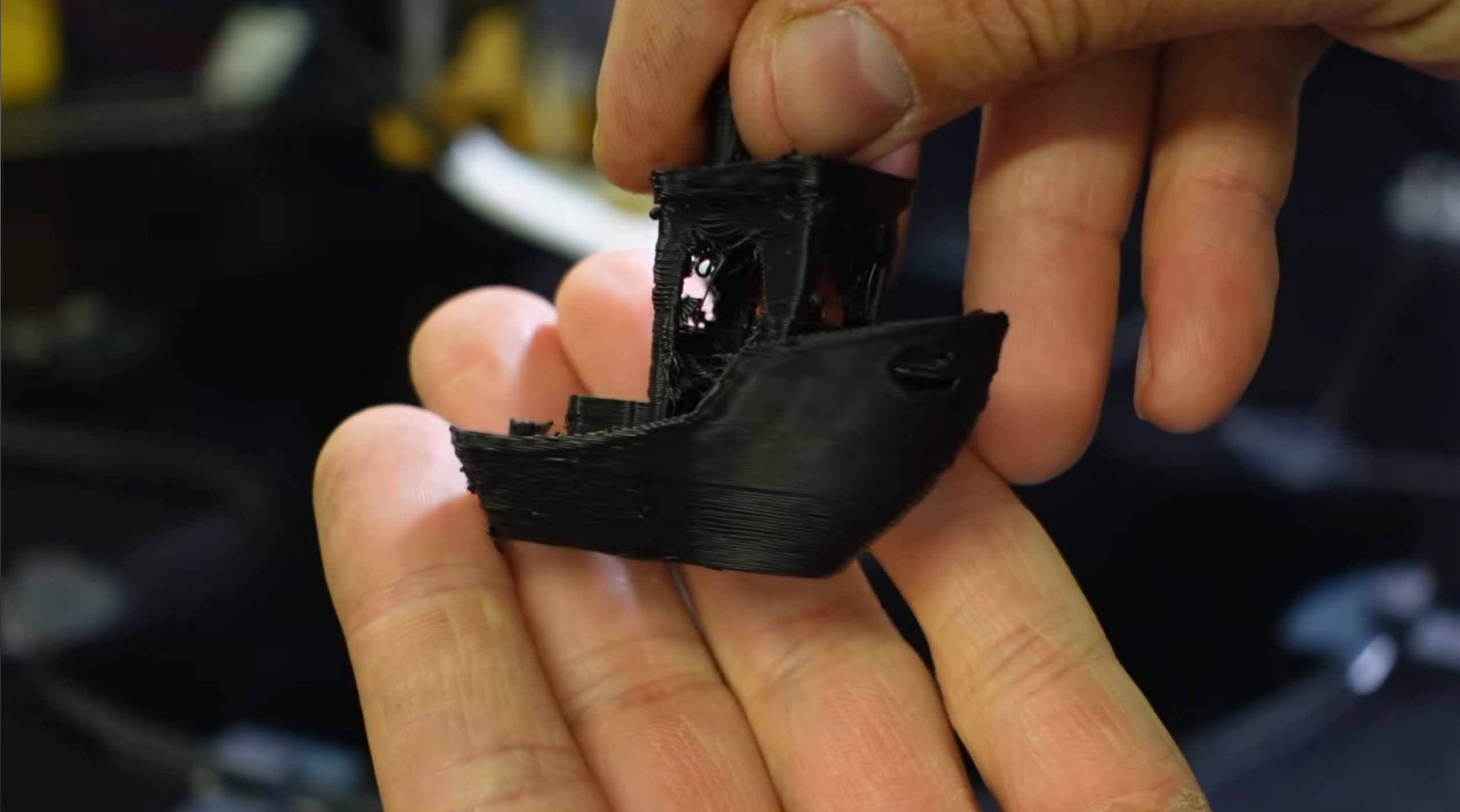
A custom cable-driven 3D printer has produced a physical 3D Benchy in under 60 seconds after its developer replaced the machine’s motion platform and reduced its moving mass. Yan Roetz documented the result on Roetz 4.0, his YouTube channel covering prototyping, 3D printing, and machining. The print concludes a two-year attempt to move Minute Man below one minute, although another creator had completed a separate sub-minute run several weeks earlier.
Minute Man combines a suspended cable-actuated motion system with a custom hot end and pressurized-air cooling. Roetz built the system on a 1,300 kg Johansson Cordmatic 7000 coordinate measuring machine, whose granite structure stabilizes approximately 60 g of moving mass. Its hot end can process close to 400 mm³ of filament per second under suitable conditions, while a custom duct supplies approximately 400 liters of pressurized shop air per minute. Previous tests had reduced the Benchy print time to 74 seconds, but further gains depended on faster, reliable movement rather than additional flow or cooling.
Addressing that challenge required replacing the previous 117 g platform with a waterjet-cut carbon fiber assembly and installing lighter polymer pulleys. Paper shims provided an estimated 0.07 mm of clearance around the new platform during initial testing. Mechanical stress tests reached 1,500 mm/s and 2.5 million mm/s² of acceleration, equivalent to 250 g, before a cable attachment failed. Revised attachment points survived subsequent testing, while a tighter D-shaped pulley replaced another component that had slipped on its motor shaft. These values tested the motion system’s limits and did not represent the final printing configuration.
For the completed Benchy, the machine ran at up to 1,700 mm/s with acceleration set to 200 g and square-corner velocity at 50 mm/s. Most of the print required material flow near 200 mm³/s. Roetz prepared the model in OrcaSlicer, an open-source slicing application, using a 0.5 mm nozzle, 0.25 mm maximum layer height, two walls, three top and bottom layers, and 10% line infill. Reduced bridge and top-surface densities limited how much deposited material required immediate cooling.

Material testing compared two PLA formulations. Fiberlogy, a Polish 3D printing filament manufacturer, supplied Impact PLA, which resisted cracking and produced a stronger part. FormFutura, a Dutch filament producer, supplied Volcano PLA, which performed slightly better under localized cooling. Roetz selected black Volcano PLA for the final attempts. He also retained line infill instead of faster lightning or combined infill configurations, estimating that more aggressive settings could remove another six to ten seconds.
Completed parts still showed stringing, rounded corners, and cooling defects around smaller features. Roetz left dimensional accuracy and strict compliance with the speed-printing rules open to viewers’ judgment. His stated objective was not a leaderboard record but a repeatable print with the highest quality his current system could produce. After replacing the slipping pulley, Minute Man completed three consecutive physical runs.

“And for what it’s worth, I’m really proud of the result, even though we’re still far away from perfect,” Roetz said. Although the video closes the twentieth and final planned Minute Man episode, work on the underlying technology will continue. Future plans include publishing the winch kinematics as an open-source system and developing speed-printing methods for medium-volume local manufacturing.
Why 3DBenchy remains a demanding speed test
Created by Creative Tools, a Swedish 3D technology reseller, 3DBenchy tests more than print speed. Its portholes, open cabin, overhangs, and narrow sections expose problems involving extrusion, cooling, retraction, and layer adhesion. These features make the stringing, rounded corners, and cooling defects in Minute Man’s finished boats relevant when assessing the sub-minute result.
More recent software tools also show how many interacting parameters shape the same benchmark. 3D Printer Simulator, released by software studio 5minlab in 2025, models print speed, filament flow, retraction, Bowden pressure lag, layer lines, and stringing while supporting G-code from OrcaSlicer. Roetz adjusted many of these variables directly, meaning the completed Benchy reflects coordinated changes to motion, extrusion, cooling, and slicing rather than maximum movement speed alone.

3D Printing Industry is inviting speakers for its 2026 Additive Manufacturing Applications (AMA) series, covering Energy, Healthcare, Aerospace, Space and Defense, and Software. Each online event focuses on real production deployments, qualification, and supply chain integration. Practitioners interested in contributing can complete the call for speakers form here.
To stay up-to-date with the latest 3D printing news, don’t forget to subscribe to the 3D Printing Industry newsletter or follow us on LinkedIn.
Explore the full Future of 3D Printing and Executive Survey series from 3D Printing Industry, featuring perspectives from CEOs, engineers, and industry leaders on the industrialization of additive manufacturing, 3D printing industry trends 2026, qualification, supply chains, and additive manufacturing industry analysis.
Featured photo shows Sub-minute 3DBenchy printed on the Minute Man system. Photo via Roetz 4.0.







