

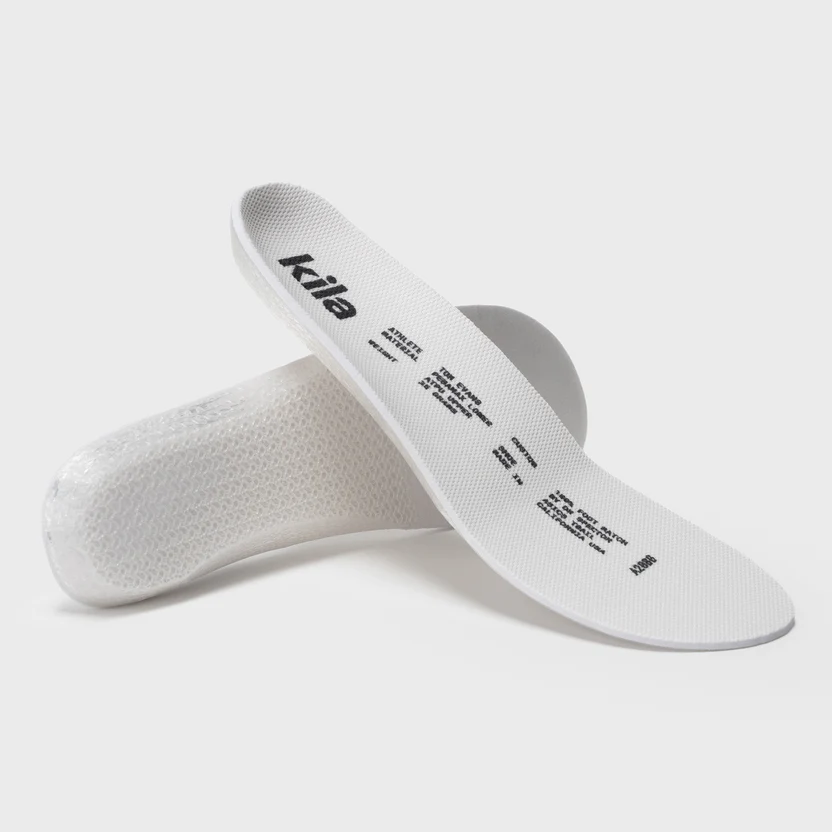
Kila has launched Version 2.0 of its custom running insoles, built around NanoPEBA — a proprietary foam compound from the same Peba material family used in elite carbon-plated racing shoes. Runners scan their feet at home via iPhone FaceID technology, and the insoles are manufactured at Kila’s new San Diego facility before being shipped directly to the customer.
“Custom insoles are probably the most underrated piece of kit in running,” said British ultrarunner Tom Evans, the 2025 Ultra-Trail du Mont-Blanc (UTMB) champion, who trained and raced in Kila Insoles throughout his title-winning campaign. “Been in Kila insoles since before UTMB last year. Haven’t taken them out since.”
“Working directly with elite athletes like Tom Evans and other podium contenders gave us real-world insight into what the fastest runners truly need,” said Ben Thomas, Co-Founder of Kila. “Version 2.0 takes that feedback and pushes the limits even further — delivering the lightest, fastest, and highest energy return custom insoles ever made.”
Version 2.0 centers on NanoPEBA foam, which Kila claims delivers superior energy return compared to conventional orthotic materials by springing back through each footstrike rather than passively absorbing force. Additional refinements include updated arch mapping, reinforced construction for high-mileage durability, and faster turnaround from the new San Diego production facility — allowing local manufacturing at scale for the first time.

From Clinic to Starting Line: AM Is Redefining the Custom Insole
Custom orthotics have traditionally been designed around injury correction, not speed. What’s changing is the combination of two converging technologies: smartphone-based 3D scanning, which removes the need for a clinical visit to capture precise foot geometry, and additive manufacturing (AM), which allows that data to be translated directly into a custom-manufactured insole. Kila’s v2.0 sits at that intersection — using iPhone FaceID scanning to generate the fit data and 3D printing to produce a Peba-based insole tuned for performance rather than rehabilitation.
The scan-to-print model for custom insoles has been building momentum across the industry. Fitasy announced a system combining spatial AI and digital light projection 3D printing, where users scan their feet in both weight-bearing and relaxed positions via smartphone to generate a precise 3D model. On the production side, PioCreat launched a clinical insole system capable of producing custom 3D printed insoles in under 35 minutes using flexible materials like TPU, while Florida-based Syntilay brought AI-assisted 3D printed footwear to consumers through a smartphone scanning workflow strikingly similar to Kila’s—applied to casual footwear rather than performance running.

The performance side of the equation has its own precedents. In 2021, Adidas and Carbon developed 3D printed Futurecraft insoles using athlete data and digital light synthesis technology, with the resulting midsoles worn by Olympic athletes at the Tokyo Games before being made available to consumers — demonstrating that 3D printing could underpin performance footwear at the highest level of competition. Kila’s bet is that the same logic applies to what sits inside the shoe, not just the shoe itself: that a custom 3D printed insole built from racing-grade Peba foam can close the performance gap that off-the-shelf orthotics have never addressed.
3D Printing Industry is inviting speakers for its 2026 Additive Manufacturing Applications (AMA) series, covering Energy, Healthcare, Automotive and Mobility, Aerospace, Space and Defense, and Software. Each online event focuses on real production deployments, qualification, and supply chain integration. Practitioners interested in contributing can complete the call for speakers form here.
To stay up to date with the latest 3D printing news, don’t forget to subscribe to the 3D Printing Industry newsletter or follow us on LinkedIn.
Explore the full Future of 3D Printing and Executive Survey series from 3D Printing Industry, featuring perspectives from CEOs, engineers, and industry leaders on the industrialization of additive manufacturing, 3D printing industry trends 2026, qualification, supply chains, and additive manufacturing industry analysis.
Featured image shows Kila Insoles v2.0. Photo via Kila.







