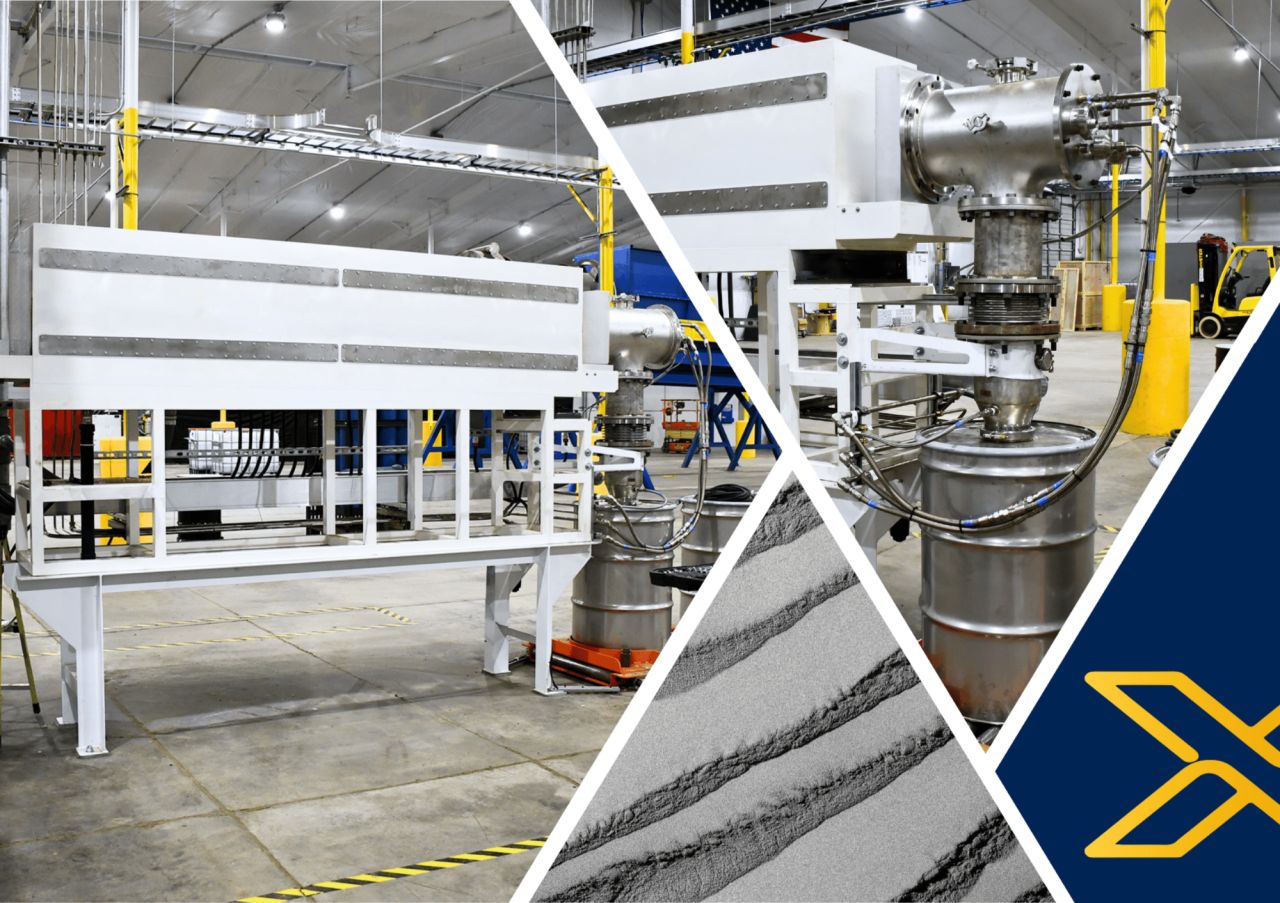
IperionX has validated GenX, a continuous version of its patented HAMR titanium powder process. Every spherical powder sample it produced met the Grade 23 oxygen specification, the extra-low-interstitial grade widely used to print medical and aerospace parts. Spherical titanium powder is the standard feedstock for powder bed fusion and other metal additive manufacturing processes, and its high cost has long limited how widely titanium printing is used.
Across four continuous campaigns totaling 41 hours at IperionX’s Virginia R&D facility, GenX turned out more than 500 kg of titanium powder at roughly 12 kg per hour. Against the company’s existing batch HAMR operations, it delivered six times the throughput over the same run time. It also used more than 75% less power, more than 45% less magnesium and over 60% less hydrogen per kilogram.
Output from each run was kept separate, and samples were pulled at random from different points for oxygen testing. The spherical powder came from two runs lasting 23 hours in total. Oxygen fell from 0.215% to between 0.072% and 0.084%, averaging 0.078%, and all eight samples came in under the Grade 23 limit of 0.130%.
The angular powder came from two runs totaling 18 hours. Oxygen dropped from 0.250%–0.323% to 0.104%–0.144%, averaging 0.126%. Seven of the eight samples met the Grade 5 limit of 0.200% for Ti-6Al-4V plate and bar under ASTM B265 and B348, and four of those also met Grade 23. The eighth sample came from a furnace run interrupted before the HAMR cycle finished, so it was excluded. IperionX expects small process adjustments to bring all angular powder within Grade 23.

From batch to continuous
Conventional titanium sponge is made through the Kroll process, which runs in discrete batches. IperionX’s hydrogen-enabled, low-temperature HAMR process has so far also run in batches. GenX applies the same chemistry continuously, removing the heat-up, cool-down, loading and unloading that eat into every batch cycle.
The magnesium saving is especially significant, because magnesium is HAMR’s largest reagent cost. Using less of it also shrinks the by-product that must be leached downstream, a benefit IperionX will quantify in later campaigns. The company also expects better equipment utilization, fewer ancillary steps, and growth through replicated production lines. It points to far lower installed capital per ton of capacity and significant labor savings, and notes that similar industrial furnaces already reach thousands of tons per year per unit.
“Achieving continuous primary titanium production has long been the ultimate aspiration for the titanium industry,” said IperionX CEO Taso Arima. “IperionX’s GenX process is a continuous titanium production platform that is more efficient to operate and easier to scale.” Arima noted that the first campaigns processed recycled titanium powder and said the results “exceeded our expectations.”
In Q4 2026, IperionX will keep optimizing the GenX furnace and integrate it into a full powder production line. It will also run technoeconomic and engineering studies for the first industrial-scale GenX line. The company says GenX is not required to reach low-cost production for its current ramp or planned Virginia expansions.
GenX also complements IperionX’s development of continuous HSPT (Hydrogen Sintering and Phase Transformation), its process for turning titanium powder into finished parts, supporting a potential pathway from continuous powder production to finished titanium components.
On August 31, the U.S. Army awarded Task Order 2 under the company’s US$99 million SBIR Phase III contract. It funds continuous HSPT and dehydrogenation capacity in Virginia. The task order has an $18.5 million base value, of which $11.5 million is funded, and options could lift it to $25.4 million. One of those options would fund a binder-jet printing and HSPT demonstration for an unnamed aerospace and defense supplier. GenX itself is not funded under the order, but together the two programs outline a continuous route from powder to finished titanium parts.
“Our next step is the engineering and economic evaluation of the first industrial-scale GenX production line,” Arima said. “We aim to establish a scalable platform for expansion that lowers production costs and brings titanium within reach of a broader range of applications.”

Racing to Cut the Cost of Titanium for 3D Printing
IperionX sees the West’s titanium problem as both a supply problem and a process problem. Russian sponge has been largely cut off since 2022, China now produces around 70% of global output, and the dominant Kroll process is costly and batch-based. IperionX’s answer is to own the full chain, from feedstock to finished parts, and to use continuous processing to bring costs down.
Across the Atlantic, UK powder producer Metalysis is seeking to address that gap. In March 2026, Metalysis secured nearly €1 million from the European Space Agency for a 24-month project to move its FFC Cambridge electrolysis process from batch to continuous or quasi-continuous titanium production. The process, developed at the University of Cambridge in 1997, reduces titanium oxide directly to solid titanium through molten salt electrolysis. That skips the chlorine-based, multi-stage melting of the Kroll route and uses less energy with fewer hazardous by-products. Metalysis currently runs it in batches, which is adequate for additive manufacturing but falls well short of what the bulk titanium market needs.
Suppliers are also going after cost and supply through recycling and scale. 6K Additive is expanding its Burgettstown, Pennsylvania campus to lift annual powder output from 200 to 1,000 metric tons, including titanium powders for aerospace propulsion. A $23.4 million DPA Title III grant covers half of that expansion, alongside proceeds from its ASX IPO. The company also holds a $1.95 million Defense Logistics Agency contract to turn military-grade scrap into high-performance powder using its UniMelt process.
Kroll made titanium possible, but it has also kept it expensive. Continuous processing, direct reduction and scrap recycling are now competing to replace it, and whichever scales first will likely set the price of titanium 3D printing.
Register now for AMA: Software 2026. Join 3D Printing Industry on 22 October for expert presentations, panel discussions and live audience Q&A exploring the software shaping additive manufacturing. Register here.
To stay up to date with the latest 3D printing news, don’t forget to subscribe to the 3D Printing Industry newsletter or follow us on LinkedIn.
Explore the full Future of 3D Printing and Executive Survey series from 3D Printing Industry, featuring perspectives from CEOs, engineers, and industry leaders on the industrialization of additive manufacturing, 3D printing industry trends 2026, qualification, supply chains, and additive manufacturing industry analysis.
Featured image shows IperionX has validated GenX. Image via IperionX.