

After more than a decade in the market, Carbon is experienced enough to know where to focus. The shift is away from expansion and spectacle, and towards making polymer additive manufacturing behave like an industrial system.
Philip DeSimone, Carbon’s co-founder and now part of the Office of the CEO, spoke at length about cost curves, materials qualification, and why many additive manufacturing companies struggle once they move beyond early adoption. The conversation ranged from funding strategy to resin economics, with little patience for the idea that better machines alone determine outcomes.
Capital discipline before expansion
Carbon’s latest $60 million funding round was led entirely by existing investors. No new capital came in. DeSimone was clear about why.
“We made a move to get towards financial sustainability on our own,” he said. “This was led 100 percent by our current investors. There’s no new outside capital put in. To be honest, we shouldn’t have to touch it. It’s really increasing the war chest for positive cash flow through this year.”
The company is not preparing for acquisitions. DeSimone dismissed the idea that additive manufacturing firms benefit from owning multiple platforms. “I’ve got no interest in adding new 3D printing technologies,” he said. “Doing one well is really, really hard. Doing six well is impossible.”
Carbon’s investment remains concentrated in markets it already serves. Industrial production, defence, and medical and life sciences account for the bulk of activity. Revenue is now split evenly across three application areas: foam replacement, dental and oral health, and performance products. Each contributes roughly a third of sales.
“Five years ago, that wasn’t the case,” DeSimone said. “That balance really sets us up for a healthy future.”
Production as the organising constraint
Carbon was set up as a production manufacturing company, not a rapid prototyping supplier. DeSimone said that position never changed, even during periods when execution drifted.
“The philosophy hasn’t changed since day one,” he said. “We lost our way from a focus area perspective over those years,” adding that over the last three years, it’s been much more about end-use production, “that’s the future.”
He drew a sharp line between prototyping demand and manufacturing demand. Prototyping shops may run machines a few hours a day. Carbon customers running production lines operate very differently. “In production environments, utilisation is everything,” he said. “You can’t have printers built like toasters. It’s about yield, reliability, and cost per part.”
Machines running 80 to 90 hours a week behave nothing like those running 10 or 15. The consequences show up in maintenance, process control, and cost accounting.
Carbon now produces more than one million customised end-use parts per week across its installed base. DeSimone pointed to footwear and dental aligners as examples of sustained, high-volume output. Some customers operate dozens of systems. Others run far more, though he declined to give precise figures.
Materials decide who gets to participate
Carbon’s internal structure reflects where effort is spent. Roughly a third of engineering staff work on hardware, a third on software, and a third on materials development. Many of the latter hold PhDs.
One thing he believes the broader industry often gets wrong is a focus solely on the 3D printer. “Materials dictate the time [to print], the printer does not” DeSimone said. “If you don’t have a V0, FST-rated material, you do not get to play in aerospace. If you don’t have an elastomer that survives 100,000 compressions, you don’t get to make shoes.” The company now offers around 60 commercially available resins, most developed in-house. New material requests arrive continuously, but not all are pursued.
“If someone needs 1,000 litres a year, it costs far more to develop the resin than you’ll ever make back,” DeSimone said. “We work backwards from applications that can justify hundreds of tons a year.”
That filtering has led Carbon into highly specific but repeatable use cases. One example under development is wheelchair cushioning, where elastomers are being designed to manage heat, moisture, and long-term loading in ways traditional foams struggle with.
“Comfort, thermal cooling, preventing bed sores, moisture wicking,” DeSimone said. “Those things become critical, and you design materials very specifically for that application.”
Qualification time is the invisible cost
Testing and certification dominate timelines in production additive manufacturing. DeSimone described this as one of the least visible cost drivers.
“Every application has 12 to 24 months of testing,” he said. “That’s just to prove you can do what you say you can do. You can burn through a lot of cash there.”
Carbon maintains a dedicated materials characterisation team to support customer qualification and quality assurance. This work happens long before volume production begins and rarely features in marketing material.
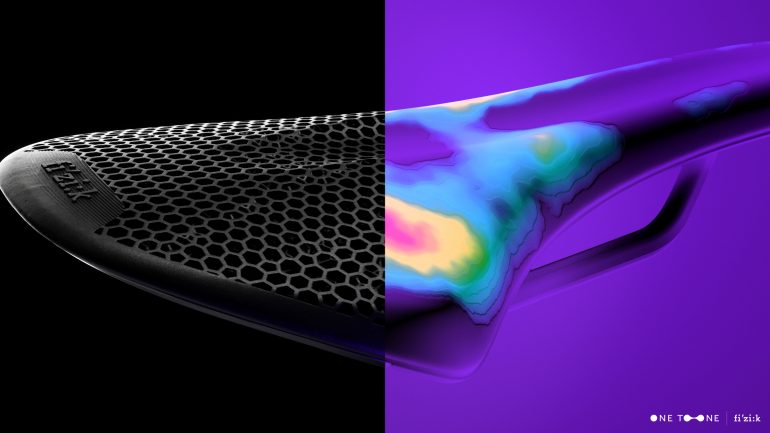
In some markets, resistance to additive manufacturing has largely disappeared. Cycling is one example. Seven of the top ten finishers at the Tour de France now use 3D-printed saddles. “If you’re a bicycle company and you don’t have a 3D saddle coming, you’re behind,” DeSimone said. Other sectors move more slowly. Even with established references, new applications typically take 18 to 24 months to reach volume production.
Cost curves behave differently in production
DeSimone returned repeatedly to how additive manufacturing cost curves are misunderstood. A familiar industry diagram shows a straight unit-cost line intersecting injection moulding at a single volume threshold. He rejected that model.
“3D printing is not a straight line,” he said. “In prototyping, it’s a straight line. If you get to large-scale production, you get a curve.” Buyers often extrapolate from one-off prototype pricing. Production behaves differently once utilisation rises, resin is purchased at scale, and process variation is reduced.
Materials dominate the economics. Hardware becomes marginal once machines are fully loaded. “Sixty to seventy percent of a helmet is material,” DeSimone said. “Every 50 cents of cost reduction in resin can be worth $10,000 at scale.”
IP pressure and competition
Carbon reviews IP enforcement every two weeks. DeSimone said infringement has been a persistent issue for several years. “In the world of the China approach and knock-offs, it’s become very valuable protecting ourselves and our investments,” he said.
The company avoids litigation where possible.
“I don’t like to spend my money on lawyers,” he said, adding that Carbon has been “quite successful” in stopping violations this year through alternative routes. The response has not been to broaden its technology portfolio, but to narrow focus and protect what already exists.
The slow work behind industrialisation
DeSimone described a sharp divide between producing many different parts once, and producing the same part a million times across hundreds of machines, multiple resin lots, and different factories.
“The amount of blood, sweat, and tears to get to do all of those things is really painful,” he said. “It takes a lot of time and a lot of effort, and it’s effort that’s happening in the background that is not seen at these shows.”
Inside Carbon, this phase is referred to as “crushing the grind.” It covers process control, materials consistency, operator discipline, and systems engineering.
“That last mile is what differentiates the okay 3D printing companies from the excellent companies,” he said.
Financing conditions are tightening. DeSimone expects weaker companies to come under pressure as investors demand evidence of production discipline rather than growth narratives.
His ambition remains large, but the route is narrow. “My goal is that every single person is interacting and has their life better by the product every day,” he said.
The path there is not another generation of machines. It is repeatable production, qualified materials, and the slow work required to make polymer additive manufacturing function as an industrial process rather than a demonstration technology.
The 3D Printing Industry Awards are back. Make your nominations now.
Do you operate a 3D printing start-up? Reach readers, potential investors, and customers with the 3D Printing Industry Start-up of Year competition.
To stay up to date with the latest 3D printing news, don’t forget to subscribe to the 3D Printing Industry newsletter or follow us on Linkedin.
Featured image shows a Visual representation of Carbon customer Fizik’s additive manufacturing workflow. Photo via Carbon.







