
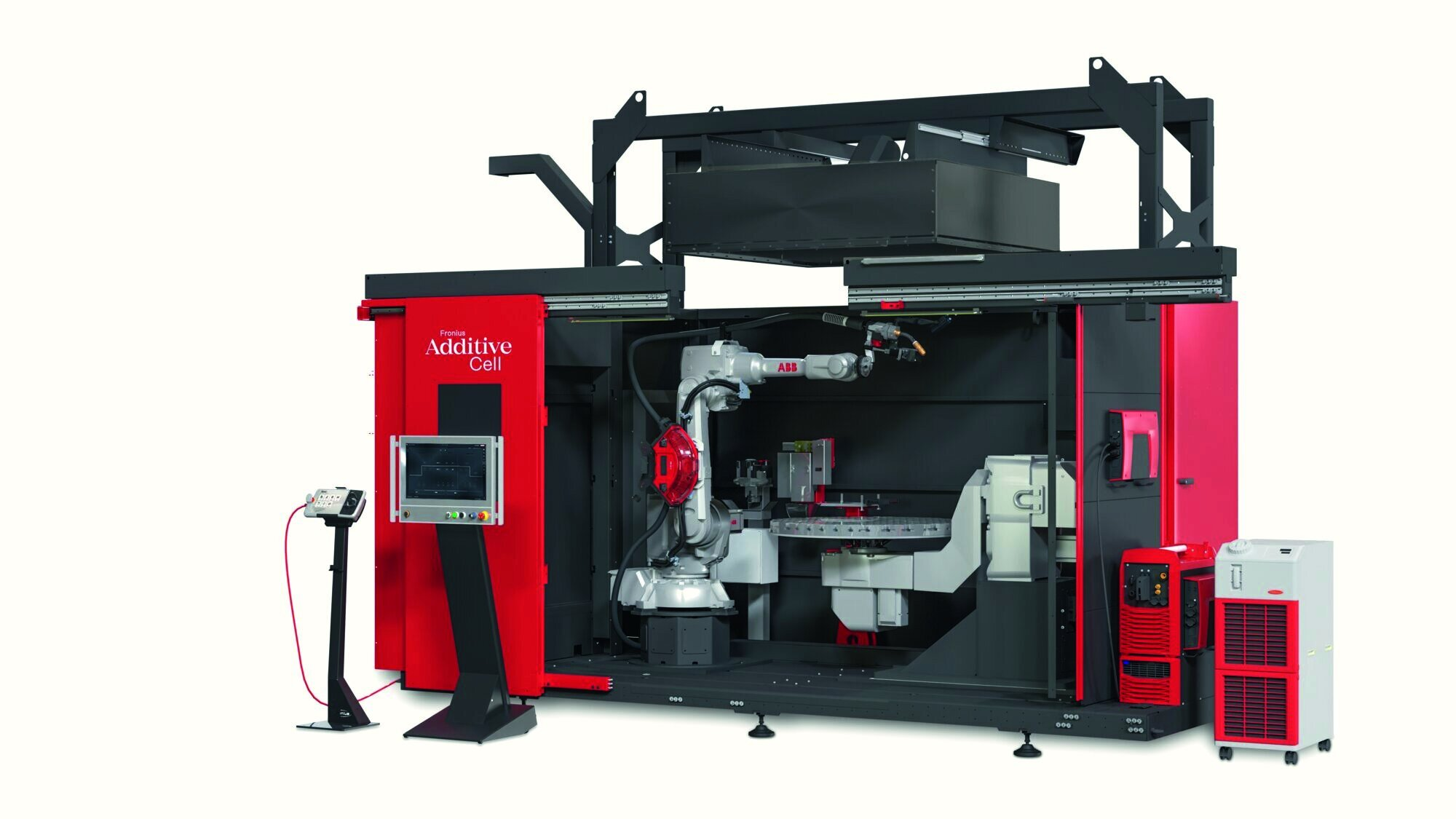
Fronius, an Austrian welding technology and automation company, has launched the Fronius Additive Cell, a turnkey Wire Arc Additive Manufacturing (WAAM) system combining welding hardware, robotic automation and additive-specific software.
Designed for industrial metal 3D printing, the system integrates the company’s CMT Additive PRO welding process with Fronius iWave hardware, Polaris cell control and its Vectris software platform. Fronius is targeting applications including spare parts, prototypes, one-off components and reverse-engineered parts across aerospace, automotive, rolling stock, pressure vessel, and oil and gas industries.
The integrated approach is intended to reduce the process development and system integration work required before manufacturers can begin WAAM production.

CMT welding adapted for additive manufacturing
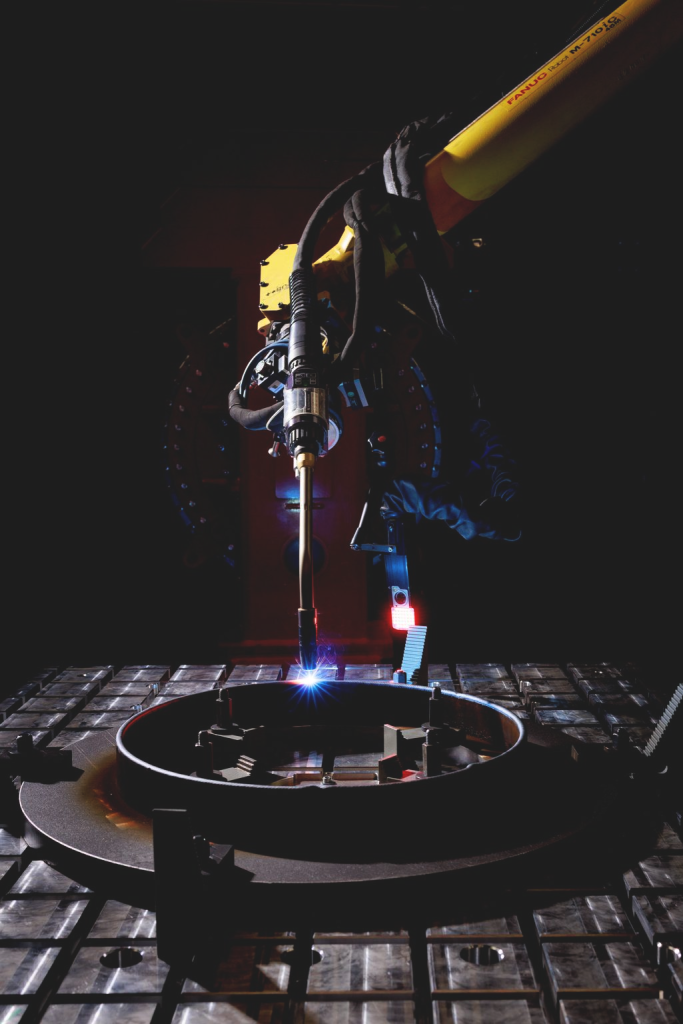
CMT Additive PRO forms the core of the Fronius Additive Cell. Based on the company’s Cold Metal Transfer (CMT) welding technology, the process has been adapted specifically for additive manufacturing.
In WAAM, or Directed Energy Deposition-Arc (DED-Arc), an electric arc melts metal wire as material is deposited in successive layers. Maintaining stable deposition is key to achieving consistent layer build-up and reducing variation across a component.
Fronius describes CMT as a relatively low-heat dip-transfer arc process capable of providing higher deposition rates than some other metal additive manufacturing processes while limiting heat input.
CMT Additive PRO adds process functions developed specifically for additive production. These include a deposition rate stabilizer, Pulsed HotStart, contact-tip-to-work-distance (CTWD) measurement and power correction.
“The CMT Additive PRO guarantees uniform and, above all, predictable layer build-up across the entire component,” said Manuel Stinglmayr, Business Development at Fronius International. “This drastically reduces scrap rates as well as the workload required for any rework.”
Inside the cell, CMT Additive PRO and the Fronius iWave welding platform carry out the deposition process, while the Polaris system provides overall control.
“The Additive Cell combines proven welding technology, intelligent control, and Fronius’s many years of welding expertise,” said Anna Dieplinger, Key Product Manager Additive Manufacturing, Automation & Digital Solutions at Fronius International. “Every component has been designed to complement the other, resulting in a stable manufacturing process.”
Geometry-specific WAAM process control
Fronius has also integrated its Vectris software bundle into the Additive Cell, bringing the machine tool service kit (MTSK) and post-processor together on a single platform.
The software includes a kinematic model, an interface adapted for additive manufacturing and validated welding operations. It can also distinguish between different areas of a component, allowing process parameters to be adjusted for features such as outer walls, panels, infill and joints.
For example, users can assign individual parameters to outer walls, panels, infill sections and component joints.
These parameter sets, which Fronius calls “build styles,” are converted into robot instructions through the FroArc welding command integrated into the post-processor. This allows the robot to switch welding parameters as it moves between different areas of the component.
The approach gives manufacturers greater control over how individual features are deposited without programming each process change separately at the robot level.
Process development alongside the hardware
Beyond supplying the cell itself, Fronius is offering process-development services through its Prototyping and Manufacturing Center.
Services include feasibility studies, process development and component production. Fronius says it can also develop, test and certify welding and process parameters for specific materials.
Validated parameter sets can then be licensed to customers as production “recipes,” with Fronius also offering complete process engineering for additive manufacturing projects.
The Additive Cell is intended for both new-part production and reverse engineering applications, including replacement components where original tooling or CAD data is no longer available.
By combining the hardware with process-development and engineering services, Fronius is aiming to simplify the transition from part design to WAAM production.
The Additive Cell and its wider additive manufacturing portfolio will be presented at Formnext 2026 in Frankfurt from November 17 to 20.
Reducing integration barriers in industrial WAAM
Fronius is not alone in trying to remove robotic integration work. Meltio and One Off Robotics introduced a turnkey metal additive manufacturing cell specifically to shorten integration and assembly.
Integration alone does not solve industrial adoption. Northrop’s experience shows that process control, testing, inspection and qualification remain significant constraints. That makes Fronius’ emphasis on validated operations and licensable parameter recipes more consequential than simply bundling hardware together.
3D Printing Industry is inviting speakers for its 2026 Additive Manufacturing Applications (AMA) series, covering Energy, Healthcare, Automotive and Mobility, Aerospace, Space and Defense, and Software. Each online event focuses on real production deployments, qualification, and supply chain integration. Practitioners interested in contributing can complete the call for speakers form here.
To stay up to date with the latest 3D printing news, don’t forget to subscribe to the 3D Printing Industry newsletter or follow us on LinkedIn.
Explore the full Future of 3D Printing and Executive Survey series from 3D Printing Industry, featuring perspectives from CEOs, engineers, and industry leaders on the industrialization of additive manufacturing, 3D printing industry trends 2026, qualification, supply chains, and additive manufacturing industry analysis.
Featured image shows the Fronius Additive Cell. Photo via Fronius International GmbH.