

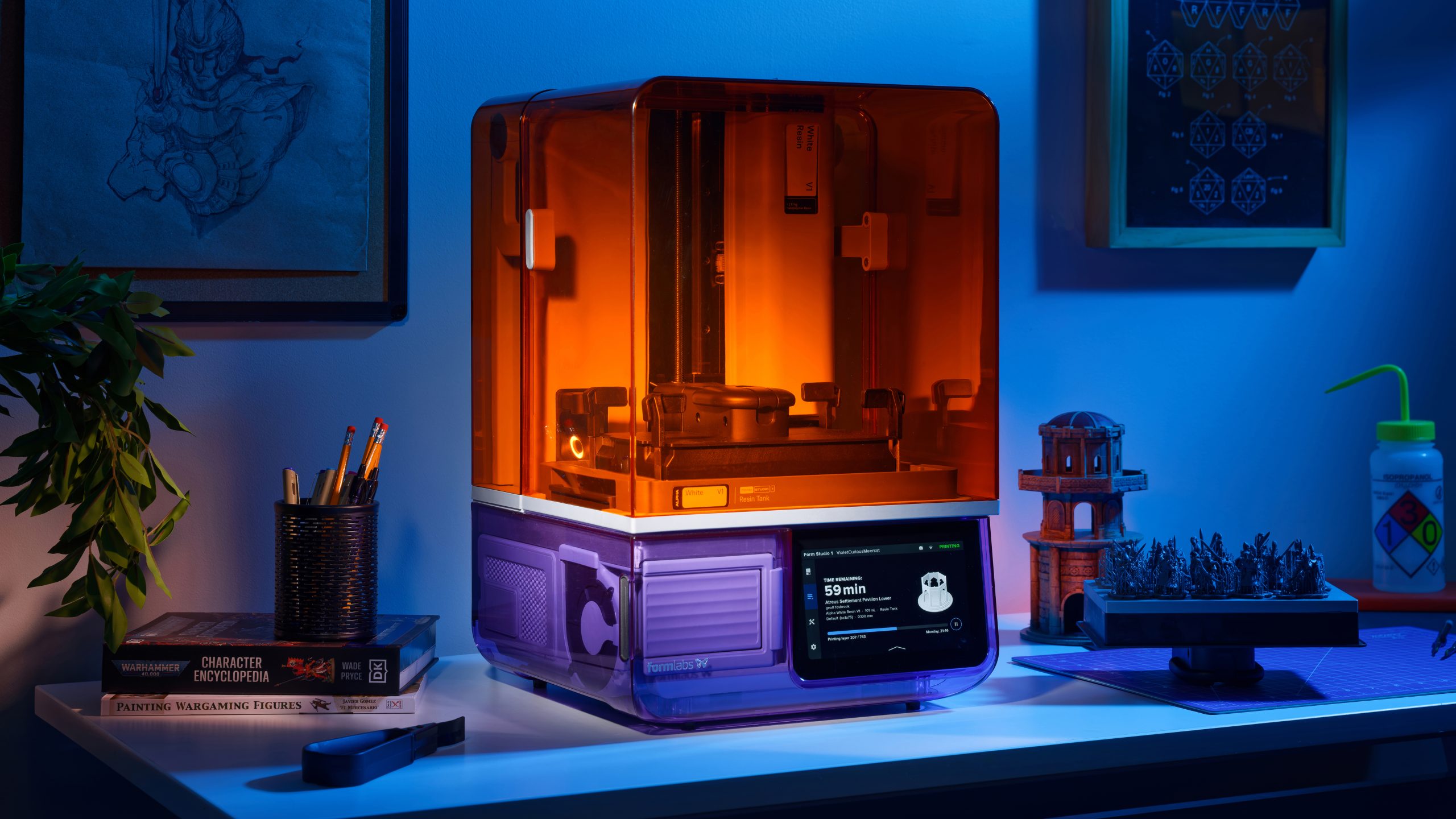
Ahead of the announcement of the Formlabs Form Studio 1, 3D Printing Industry examined comments from CEO Max Lobovsky, recruitment intelligence, a former Apple executive’s appointment, and a revealing promotional announcement in Shenzhen. Together, they pointed towards a company reconsidering the scale of its ambitions.
Formlabs has unveiled a new photopolymer 3D printer, extending its efforts to bring professional manufacturing technology to a wider market. Priced at $699, the Formlabs Form Studio 1 is marketed as the “world’s most affordable professional resin 3D printer”.
The announcement follows several developments that suggested the company was preparing something more consequential than a conventional product update. From the recruitment of specialist engineers to remarks made by CEO Max Lobovsky at the 2026 AMUG Conference, there were reasons to suspect that Formlabs was considering a substantial change in direction.
Whether that meant an entry into fused filament fabrication (FFF), a significantly less expensive resin printer or an entirely new process was initially unclear. The strongest clue eventually emerged from an unexpected source: promotional material for TCT Shenzhen, published four days before the global unveiling.
The announcement, combined with wider developments in polymer additive manufacturing, helps explain why Formlabs is seeking to broaden access to its technology, and why the competition it faces may increasingly come from companies operating outside its traditional market.
Want insights into AI and 3D printing? Register for AMA Software 2026, our free online event.

The market is moving in both directions
The commercial potential of more accessible polymer 3D printing has attracted the attention of some of the industry’s largest manufacturers.
In April 2026, HP introduced the Multi Jet Fusion 1200, a compact, lower-cost version of its established MJF technology. The machine is intended to bring powder-based polymer printing to customers who might previously have considered the investment and operational requirements prohibitive.
HP has not characterised the MJF 1200 as a response to Formlabs’ growing Fuse portfolio, but comparisons are inevitable. Both manufacturers are attempting to lower the barriers to industrial polymer printing, bringing technologies once associated with relatively expensive production equipment into smaller manufacturing environments.
HP has also extended its presence in filament extrusion. Its Industrial Filament 3D Printer 600 High Temperature became generally available in the United States and Canada this year, demonstrating that the company sees opportunities across multiple polymer manufacturing processes.
This is a two-way street. While established industrial equipment manufacturers move towards lower-cost machinery, desktop printer manufacturers are increasingly targeting professional and industrial customers. The scale of the market helps explain why.
According to CONTEXT, global entry-level 3D printer shipments increased 39% year-on-year in the first quarter of 2026, accompanied by 54% revenue growth. In its latest figures, published on 13 October, CONTEXT reported that global 3D printer hardware revenue increased 31% in the second quarter, driven by continued entry-level demand and a recovery in industrial equipment spending.
Research published by AMPOWER provides another perspective. Its 2026 report estimates that the desktop polymer printing market, comprising equipment priced below €10,000, has been growing at approximately 30% annually. In 2025, revenue from this segment approached the combined equipment revenues of industrial metal and polymer additive manufacturing.
That changes the competitive calculation for established manufacturers. Increasingly capable, inexpensive printers are being deployed in manufacturing environments, blurring a distinction between consumer and professional equipment that once appeared much clearer. For companies like Formlabs, there are two challenges: make industrial technology more affordable and respond to desktop manufacturers moving upmarket.

What Max Lobovsky said at AMUG
Speaking at the 2026 AMUG Conference in March, where he received the Innovators Award, Formlabs co-founder and CEO Max Lobovsky appeared acutely aware of this changing market. Discussing the company’s original ambition of making 3D printing more accessible, Lobovsky acknowledged that Formlabs remained far from achieving that goal.
“Today we’re not really focused on anyone. We are focused on professional users, people who are trying to make something for their job,” he said, before suggesting the company could eventually broaden that focus. He singled out Bambu Lab as evidence of the opportunity.
“Bambu is by far the largest company in 3D printing,” Lobovsky told attendees, estimating that the Chinese manufacturer generated well over $1 billion in revenue and sold more than a million machines annually.
He went further, suggesting that Bambu Lab’s professional customers alone could make it the largest professional 3D printing company. These were Lobovsky’s estimates, rather than audited comparisons across manufacturers. Nevertheless, the remarks were striking coming from the CEO of one of the companies most closely associated with professional desktop printing. More revealing was his assessment of Formlabs’ own opportunities.
“If you look around this room, and look at all the different things that are manufactured in this room, there’s hundreds of manufacturing processes required to make all the things in this room, and we cover two of those processes,” Lobovsky said.
He identified expanding into additional manufacturing processes as one of the straightforward ways Formlabs could grow. Later, he returned to the same point, suggesting the company could apply its approach to making equipment cheaper, easier to operate and more reliable across additional categories of digital fabrication tools.
The remarks invited speculation about whether Formlabs might eventually move into filament extrusion. That possibility was reinforced by an observation at the AMUG event in Reno, where Lobovsky was seen taking a close interest in another exhibitor’s high-temperature 3D printer. The visit might have reflected nothing more than the engineering curiosity of someone who has consistently stressed the importance of understanding competing technologies.
Another piece of the picture emerged from recruitment. Sources familiar with the matter have told 3D Printing Industry that Formlabs has been actively seeking expertise in fused deposition modelling (FDM).
The precise responsibilities associated with that recruitment activity have not been established, nor is there evidence connecting it directly to today’s launch. Nevertheless, it raised the possibility that Formlabs was developing capabilities beyond its established SLA and SLS technologies.
An FFF printer would provide a relatively direct route into a substantially larger installed market, while allowing Formlabs to bring its hardware, software and materials approach to customers already familiar with its products.

An Apple veteran joins Formlabs
A further development came in August, when Formlabs appointed Dan Riccio, Apple’s former Senior Vice President of Hardware Engineering, as a strategic adviser and investor. Riccio spent more than two decades at Apple, overseeing hardware development across products including the iPhone, iPad and Mac. His role at Formlabs includes advising on product development, design and operational scaling.
The appointment coincided with changes to the company’s leadership, including Lobovsky becoming chairman while retaining his CEO position and Chief Product Officer Dávid Lakatos becoming president. Formlabs presented the changes as preparation for a new phase of growth.
“As we scale Formlabs into the next generation of manufacturing hardware, learning from Dan is going to make our team stronger and our products better,” Lobovsky said when announcing the appointment.
Riccio’s experience is particularly relevant to a company seeking to simplify complex hardware while expanding production and distribution. His involvement does not establish that Formlabs is developing an FFF printer, nor should it be interpreted as evidence of his participation in today’s product development. Nevertheless, it adds weight to the broader picture of a company preparing to operate at greater scale.
The clue from Shenzhen
For all the circumstantial evidence pointing towards possible expansion into filament printing, the most revealing information about today’s announcement came from TCT Shenzhen. On 10 October, the exhibition organisers published a promotional article announcing that Formlabs would unveil a mystery product during an event on 15 October.
The announcement carried the Chinese heading:
光固化技术新阶段 – 让人人皆可触达专业级制造
Translated, this reads approximately: A New Stage in Photopolymerization Technology – Making Professional Manufacturing Accessible to Everyone.
Unlike the wider strategic clues, the wording pointed directly towards photopolymer printing. It was also unusually explicit about the intended positioning: professional manufacturing capabilities offered to a broader audience.
For 3D Printing Industry, this was the most compelling pre-announcement evidence that the imminent launch would involve resin-based technology rather than FFF. The Shenzhen event was scheduled for 10:30–11:30 local time on 15 October at the 3D Genius Hub, following Formlabs’ global announcement on 14 October. The organisers also promised an opportunity for invited creators to question the company’s product team.
While the promotional material did not disclose the product’s technical characteristics, it provided an important indication of the direction Formlabs intended to take. Also online were headlines for reviews of the Form Studio 1 – demonstrating the difficulty of keeping a new product launch under wraps.
This is a useful distinction, entering FFF would represent a new printing process for Formlabs. Making photopolymer printing significantly more accessible would instead extend a strategy the company has pursued since its founding, but potentially at a substantially different price point.
Why the choice of technology matters
At AMUG, Lobovsky offered another clue to how Formlabs approaches such decisions.
Asked about the transition from laser-based SLA to LCD-based printing with the Form 4, he acknowledged that the company could have moved sooner. “We should have, ideally with perfect play, released an LCD-based system, like a year or two earlier,” he said.
His explanation was that engineering companies should concentrate on the problem they are solving rather than becoming attached to particular technical solutions. For a customer seeking accurate, reliable polymer parts, the value of a printer depends on its capabilities, operating costs, materials and ease of use. The technical elegance of the underlying process matters primarily to the extent that it delivers those outcomes.
Discussing the long-term economics of Formlabs, he said the company expected hardware development eventually to stabilise, while materials would become a much larger business by revenue than equipment.
An expanded installed base of lower-cost photopolymer printers could support that model. More customers using compatible resins would create opportunities for recurring materials sales, provided Formlabs can maintain attractive operating economics against less expensive alternatives. For customers, however, the initial purchase price tells only part of the story. Material costs, consumables, washing and curing requirements, and the range of usable resins will help determine whether a lower-cost machine can truly broaden professional adoption.
A different definition of progress
The significance of today’s launch extends beyond a new machine. Formlabs has built its business on making sophisticated 3D printing processes more accessible. Its expansion from SLA into SLS, including the acquisition of Micronics in 2024 and the introduction of the Fuse X1 earlier this year, demonstrates a willingness to enter new market segments and reconsider the economics of established technologies.
But the rapid expansion of desktop polymer printing has changed the meaning of accessibility. What once meant bringing equipment costing tens or hundreds of thousands into smaller engineering departments now increasingly means competing with machines costing a fraction of that amount.
Towards the end of his AMUG interview, Lobovsky suggested that additive manufacturing companies have devoted considerable attention to advanced systems and sophisticated individual demonstrations. He argued that equal attention should be paid to the scale at which technologies can be deployed.
That observation provides a useful way to understand Formlabs’ latest announcement.
The company is pursuing a larger audience for professional manufacturing tools at a time when desktop printer manufacturers are demonstrating that accessibility can be an enormously successful commercial strategy.
The Shenzhen announcement was the strongest clue to the immediate product. Lobovsky’s remarks, the company’s recruitment activity and its appointment of an experienced consumer hardware executive point towards questions about what comes next. An FFF product remains unconfirmed, and the available evidence does not establish that one is in development.
What is clearer is that Formlabs sees room to grow well beyond its current customer base. The industry’s next competitive advantage may depend less on who can demonstrate the most sophisticated printing technology than on who can put useful manufacturing capability into the greatest number of hands.
Register now for AMA: Software 2026. Join 3D Printing Industry on 22 October for expert presentations, panel discussions and live audience Q&A exploring the software shaping additive manufacturing. Register here.
To stay up to date with the latest 3D printing news, don’t forget to subscribe to the 3D Printing Industry newsletter or follow us on LinkedIn.
Explore the full Future of 3D Printing and Executive Survey series from 3D Printing Industry, featuring perspectives from CEOs, engineers, and industry leaders on the industrialization of additive manufacturing, 3D printing industry trends 2026, qualification, supply chains, and additive manufacturing industry analysis.
Featured image shows the Formlabs Form Studio 1. Photo via Formlabs.







