


Discover exclusive software insights at AMA: Software 2026, on October 22. Register for free!
AM Europe, the additive manufacturing initiative run by European manufacturing technologies association CECIMO, is urging the European Commission to fund shared qualification pathways for 3D printed parts used in aerospace, defence, energy and medical devices. The call heads a package of six policy recommendations published in September 2026, built on a survey of 83 research organisations across 18 countries.
The findings are split across two companion papers, Mapping European Additive Manufacturing Research Capabilities and Building a Connected European Additive Manufacturing Innovation Ecosystem. Their shared conclusion is that Europe lacks neither expertise nor equipment. What it lacks is a way to turn that expertise into certified production. Testing labs, alloy know-how and monitoring software are plentiful, but they are divided by institutional, national and sectoral boundaries. As a result, companies, especially smaller ones, have no obvious path from a successful demonstration build to an accepted part.
Six steps from lab to production line
The qualification proposal asks Brussels to support common reference parts, agreed defect categories, harmonised test protocols and joint validation exercises. These would bring research centres, end users and certification bodies together. AM Europe argues this would cut the cost of approving printed components and give SMEs routes they could never build alone.
The second proposal targets data. Publicly funded groups would feed results into a common AM fault database that uses agreed terminology and interoperable formats. Benchmark parts would then be used to check whether a monitoring tool trained on one machine still holds up on another material or at another site.
Third, the papers propose a connected network of regional deployment hubs. These would offer design help, shared machines, pilot runs, training and business-case assessment. The hubs would also give honest advice on when printing is not the right answer.
A fourth measure is a searchable European directory of publicly backed facilities. It would list equipment, supported materials, test services and contact points, and AM Europe and the hubs would match companies to suitable sites.
The fifth recommendation would require any publicly funded AM project to name a credible deployment route before it closes. That route could be a follow-on industrial pilot, a transfer to a regional hub, continued testing, engagement with a certifier or a handover to an industrial partner.
Finally, the initiative wants sector-specific demonstrators focused on high-value repair, obsolete spares, mission-critical components, patient-specific medical products and material-efficient manufacturing. Each demonstrator would pair an industrial user with a testing organisation and certification expertise.

What the map shows
The surveyed organisations include research and technology organisations, universities, applied research centres and regional platforms. They are based in the EU, the UK, Switzerland, Türkiye, Ukraine and Israel. Each was scored for activity in seven capability areas, and many appear in several.
Metal AM and advanced materials lead with 66 organisations, or 80 percent. Circularity, repair and industrial uptake follows with 65, and testing, inspection and quality assurance with 63. Smaller but substantial groups cover aerospace and defence (35), polymers, composites and other non-metals (32), AI and digital process control (31), and medical, biomedical and dental work (25). AM Europe stresses that these counts measure the presence of activity, not its scale or maturity.
The metals work spans nickel, titanium, aluminium and copper alloys, steels, metal matrix composites and intermetallics. HIGMAM received €1.49 million for hierarchical gradient metals, and Ti-ADVANCE received €252,180 for printable, defect-resistant titanium alloys. The papers identify feedstock consistency, repeatability, fatigue, surface finish and post-processing as the persistent technical hurdles.
On the digital side, groups are using thermal imaging, acoustic signals, high-speed cameras and melt pool data to catch builds that drift out of their process window. InShaPe, MANUELA and RE-MAKE together account for close to €21 million from Horizon Europe and its predecessor programme. However, data ownership disputes, incompatible metadata and small training sets limit how far these models can be reused.
Inspection capacity is extensive, including CT scanning, ultrasonics, fatigue analysis and residual stress evaluation. The VTT-led NUCOBAM project, worth €4.07 million with €3 million from Euratom, applied this capacity to nuclear-critical parts. Other notable projects include ORGANIC, involving Tampere University and SUPSI, which secured €4.99 million for recyclable biocomposites. SUSTRONICS, valued at €29.99 million, brought printing into circular electronics. In healthcare, Print4Life (€4.63 million), AffordBoneS (€215,534) and Inkjet BioAM (about €5.99 million) cover training, bone scaffolds and translational investment. Defence-specific EU funding remains thin, so much relevant work enters through dual-use repair and alloy programmes.
Where results stall
Several cross-cutting barriers explain why this capability rarely reaches production. Access terms, prices and equipment lists differ so much between centres that smaller firms struggle to identify the right lab for a given question. The effort involved in applying for EU funding, with no guarantee of success, drives many organisations towards simpler national, regional or industrial funding. Datasets and reference parts often stay inside consortia, which forces new projects to repeat groundwork. And when a grant ends, prototypes and process parameters can sit in archives because nobody owns the customer trials or certification work that comes next.
AM Europe represents more than 700 companies through national members ADDIMAT (Spain), AITA and UCIMU-Sistemi per Produrre (Italy), Additive Manufacturing UK, Additive Manufacturing Austria, Metaltechnology Austria and Switzerland’s Swissmem. The group argues that 3D printing should be treated as a strategic industrial capability. In its view, the technology’s contribution to competitiveness, resilience, defence readiness and medical innovation depends on Europe moving from research excellence to coordinated deployment.
Europe’s push to connect a fragmented AM landscape
The reports are the first evidence-based policy push from AM-Europe, which CECIMO set up with UCIMU, AITA3D, ADDIMAT, FMTI, SWISSMEM and AMUK to give European additive manufacturing one voice. Its remit covers policy advocacy, standardization, market intelligence, skills and engagement with EU institutions. The papers follow CECIMO’s Manifesto for a Competitive European Additive Manufacturing Sector, which called for a coordinated EU AM strategy and a dedicated public-private entity to steer policy, standards and R&D. The six recommendations turn those broad goals into concrete mechanisms.
Other groups are tackling the same fragmentation. AM-Platform joined Addliance, the European AM Hubs Alliance, as a Core Member, adding a network of more than 500 stakeholders across over 25 countries. In the north, the Nordic Additive Manufacturing Alliance unites Finland, Sweden, Norway and Denmark. Between 2026 and 2028 it will map capabilities, identify sector needs and draft a long-term roadmap.
Qualification is drawing dedicated investment as well. In Spain, Sicnova opened CEDAEC, the country’s first centre for certifying 3D printed defence components. In the US, ASTM International’s AM Center of Excellence launched the Additive Manufacturing Certification Committee to set common audit criteria for AM suppliers.
Europe has the capability. The open question is whether alliances, hubs and common qualification rules can connect fast enough to give companies one clear route from prototype to certified part.
Register now for AMA: Software 2026. Join 3D Printing Industry on 22 October for expert presentations, panel discussions and live audience Q&A exploring the software shaping additive manufacturing. Register here.
To stay up to date with the latest 3D printing news, don’t forget to subscribe to the 3D Printing Industry newsletter or follow us on LinkedIn.
Explore the full Future of 3D Printing and Executive Survey series from 3D Printing Industry, featuring perspectives from CEOs, engineers, and industry leaders on the industrialization of additive manufacturing, 3D printing industry trends 2026, qualification, supply chains, and additive manufacturing industry analysis.
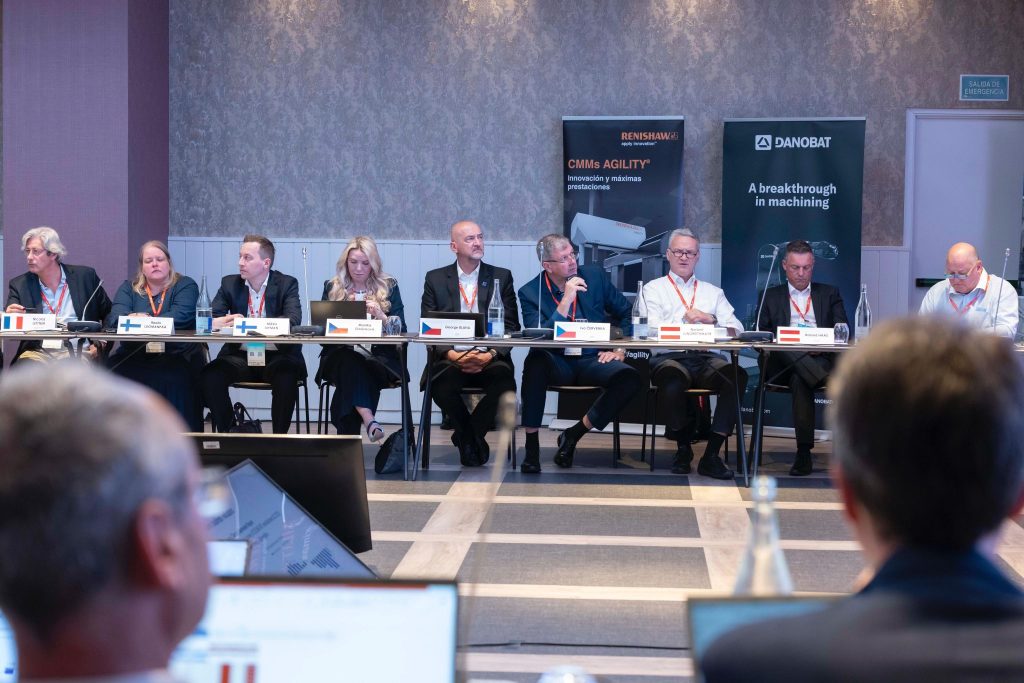
Featured image shows CECIMO representing Europe’s manufacturing technology sector before the European Commission. Photo via CECIMO.







