

Discover exclusive software insights at AMA: Software 2026, on October 22. Register for free!
German additive manufacturing software developer amsight is heading DIQAM (Digital Qualification Framework for Additively Manufactured Space Components), a new European Space Agency (ESA) project aimed at speeding up how 3D printed parts for launchers and spacecraft are qualified. The initiative was presented on October 14 at the ESA Future Space Transportation Autumn Session 2026 in Paris.
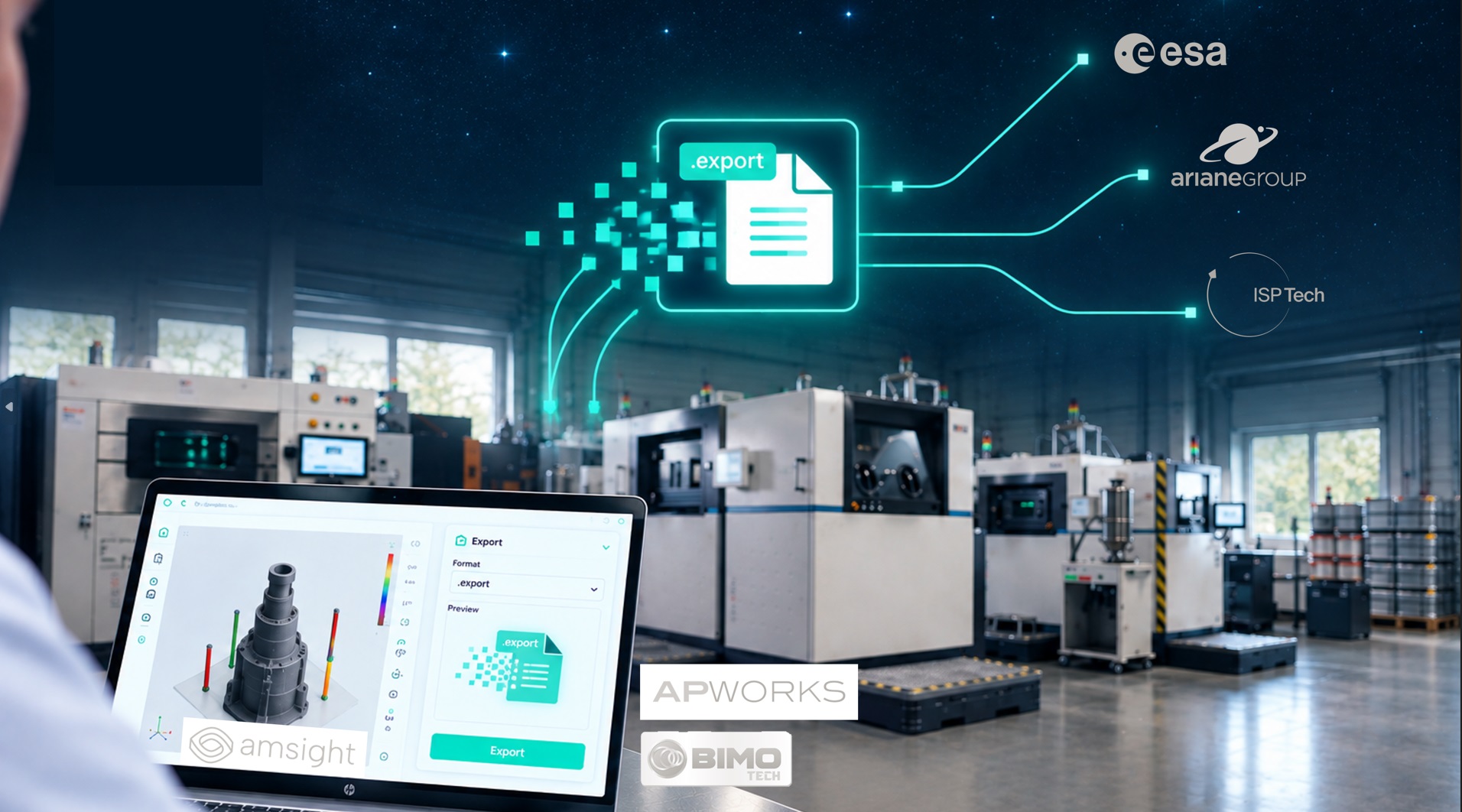
Running for 12 months from September 2026, DIQAM is funded under ESA FIRST!, a program covering simulation and intelligence technologies for space transportation, and is supported by the agency’s Future Space Transportation (FLPP) team. amsight is joined by a consortium spanning launch, propulsion, manufacturing, materials, and research: ArianeGroup, InSpacePropulsion Technologies , APWORKS, Bimo Tech, and Fraunhofer IAPT
The project’s central output will be a Digital Qualification Evidence Framework that links every stage of an additively manufactured part’s history into a single, reusable digital chain. Process parameters, powder and material records, machine and sensor data, post-processing logs, CT inspection results, and mechanical test results are to be connected rather than stored as separate documents. Alongside the framework, the partners will produce a space-specific reference specification, a Digital Part Qualification File, and a software prototype capable of automatically ingesting data, aggregating evidence, and running statistical evaluations across the AM supply chain.
“The DIQAM project is important for us at ESA because it develops a digital qualification framework that can systematically reuse qualification data, reduce redundant inspection and testing, and accelerate certification, enabling realistic and efficient use of additive manufacturing for European space systems,” said Daniel Chipping, Systems Engineer at ESA.

Two flight-relevant demonstrators
The framework will be tested on two industrial parts. The first is a Phase Change Material container from ArianeGroup intended for Ariane 6. The second is a 4U propellant tank from ISPTech, which forms the core of the company’s CubeSat propulsion system. The 3D printed tank is engineered to withstand high operating pressures while fitting inside standard CubeSat satellite structures.
For ISPTech, the motivation is practical. The company currently checks the quality of AM parts from its suppliers by hand. “Relevant information is often buried in extensive PDF reports, making it difficult to access, validate, and reuse. It is nearly impossible to compare data consistently across different suppliers and sources,” said Lukas Werling, CEO and Co-founder of ISPTech. He added that a standardized digital file format would let the firm build a robust statistical database and ultimately cut testing effort for a subsystem he described as critical to every spacecraft.
Tackling AM’s qualification bottleneck
Additive manufacturing already enables lighter, more efficient, and geometrically complex components for launchers and propulsion systems. Proving those components are fit for flight, however, remains slow and conservative. Qualification today typically depends on static reports, extensive inspection and CT scanning, companion test specimens, and manual assembly of evidence, a process that is repeated rather than reused from one build to the next.
Contract manufacturers feel that burden directly. APWORKS expects DIQAM to collapse a time-consuming reporting task. “Today, compiling and interpreting all the quality evidence for a single part can take several hours. With DIQAM, we aim to reduce this effort to just one click,” said Andreas Funcke, CTO at APWORKS.
Implications beyond space
Although DIQAM targets space hardware, the consortium argues its approach is relevant to any regulated AM sector where scattered evidence, manual reporting, and repeated qualification slow production. The model the project pursues treats quality evidence as structured, machine-readable data that can feed statistical process control, rather than as a stack of documents compiled after the fact.
“Customers in regulated sectors do not want more files,” said Peter Lindecke, CCO at amsight. “They want confidence. They want to know that powder, process, inspection, and test data are connected, traceable and available for decisions. DIQAM is a space project, but the lesson applies to every manufacturer trying to move AM from capable to dependable production.”

Building the evidence chain for production AM
DIQAM builds on amsight’s push to position its software as an AM-specific quality layer that links powder, process, machine, and inspection data at part level. Service providers including MMB Volum-e, AM North, and Additive Willmann have adopted the platform to strengthen traceability and cut manual documentation in certified production.
In the US, NASA has tapped Phase3D for flight qualification research that will capture more than 50,000 inspected build layers on an EOS M300-4, with software aggregating the data into unified qualification workflows across machines and facilities.
On the defense side, America Makes and NCDMM selected 25 teams for a $10.5 million metal AM supplier qualification program setting common training and audit requirements for LPBF and DED suppliers, shifting the focus from qualifying parts to qualifying suppliers.
The bottleneck is no longer printing the part but proving it. DIQAM aims to give Europe’s space sector a shared, reusable way to do that.
Register now for AMA: Software 2026. Join 3D Printing Industry on 22 October for expert presentations, panel discussions and live audience Q&A exploring the software shaping additive manufacturing. Register here.
To stay up to date with the latest 3D printing news, don’t forget to subscribe to the 3D Printing Industry newsletter or follow us on LinkedIn.
Explore the full Future of 3D Printing and Executive Survey series from 3D Printing Industry, featuring perspectives from CEOs, engineers, and industry leaders on the industrialization of additive manufacturing, 3D printing industry trends 2026, qualification, supply chains, and additive manufacturing industry analysis.
Featured image shows amsight leads ESA-backed DIQAM project. Image via amsight.







