DEEP Manufacturing, a specialist in wire arc additive manufacturing (WAAM) for safety-critical structures, has become the world’s first and only fully DNV-approved wire arc additive manufacturer for pressure vessels for human occupancy (PVHOs), pressure hulls, and related equipment and materials, 18 months after launching in January 2025. The company now operates two facilities, in Bristol, UK, and Houston, Texas, capable of taking a large-scale metal component from print through to a certified, service-ready part on a single site.
CEO Peter Richards framed the milestone as validation of a bet the company made at launch rather than a response to sudden demand: “We’re not seeing a spike in demand for large-format additive manufacturing. We’re seeing the market arrive at where we always believed it was heading.”
From single site to certified, on-site production
DEEP Manufacturing has grown from one facility to two, moving into 24/7, DNV-approved certified production. The company has already delivered components including hemispheres, cylinders, propeller blades, and material development blocks to customers, and has expanded its materials portfolio to cover carbon steel, stainless steel (ER316LSi), duplex and super duplex (UNS S32750), nickel aluminium bronze (ER CuNiAl), copper alloy (ERCuNi30), and aluminium (ER2319/2219).
That expansion has been supported by new equipment at the Bristol site, including a next-generation Rollerbot 2.0 system, additional WAAM robots, and new CNC machining capability, which together let components move from first pass through to final certification without leaving the facility. For customers in defence, aerospace, energy, and maritime sectors, the company says that setup delivers lead times up to three times faster than casting or forging, without compromising the certification safety-critical components require.

Certification as the differentiator
Richards positioned DNV-approved certified production, as what separates DEEP Manufacturing from competitors that can print large-format components but cannot qualify and sign them off themselves, a distinction he described as increasingly important for customers operating in high-integrity environments. That combination of in-house scale and certification also underpins how the company positions itself against traditional casting and forging routes, where those stages are typically handled by separate suppliers rather than one integrated site.
“Eighteen months ago, this was a single site and an idea,” Richards said. “Today it’s a facility that can take a component from design to raw print to a certified part ready to ship. That’s not just growth for us, it tells you how quickly this market has moved, and we’ve built to meet it.”
A transatlantic buildout
The Bristol expansion runs alongside DEEP Manufacturing’s move into the US earlier this year with the new Houston facility, backed by parent company DEEP’s $100 million investment in a permanent engineering and development hub in Florida.
Looking ahead, Richards said the next phase centers on scaling further rather than proving the model works: “The next stage of growth is more systems, more sites, and pushing WAAM further into industrialisation, without ever compromising on the certification our customers depend on.” He added that the first 18 months were about proving the approach works — “From here, it’s about proving how far it can scale.”

A Category With No Competitors Yet
DEEP Manufacturing’s exclusivity claim holds up because pressure vessels for human occupancy are a narrower, higher-stakes category than pressure vessels in general. A PVHO is a vessel that encloses a person inside a pressure differential, covering things like submersibles, diving bells, and hyperbaric chambers, rather than a sealed container holding gas or liquid for industrial use. The certification bar reflects that: a failure in an industrial pressure vessel is a leak or a rupture, while a failure in a PVHO can kill the person inside it, which is why DNV, ASME, and other standards bodies treat the two categories as fundamentally different risk classes rather than variations on the same part.
That gap shows up in DEEP’s own certification history. The company first secured DNV Approval in Principle specifically for WAAM-produced steel PVHOs in early 2025, with CEO Peter Richards stating at the time, “We are the only company in Europe with this AiP,” before spending the better part of a year moving through DNV’s audit process toward full approval.
Other WAAM players building certified pressure vessels, AML3D’s industrial containers and Fronius’s DIN-qualified components among them, operate in the broader pressure-vessel space but haven’t been reported working in the PVHO subcategory, likely because the commercial demand for 3D printed human-occupied pressure structures is still small, largely confined to subsea habitats and niche marine and defense applications DEEP itself was built to serve.
DEEP’s claim rests on one confirmed fact: no other company has been reported holding this specific certification.
3D Printing Industry is inviting speakers for its 2026 Additive Manufacturing Applications (AMA) series, covering Energy, Healthcare, Automotive and Mobility, Aerospace, Space and Defense, and Software. Each online event focuses on real production deployments, qualification, and supply chain integration. Practitioners interested in contributing can complete the call for speakers form here.
To stay up to date with the latest 3D printing news, don’t forget to subscribe to the 3D Printing Industry newsletter or follow us on LinkedIn.
Explore the full Future of 3D Printing and Executive Survey series from 3D Printing Industry, featuring perspectives from CEOs, engineers, and industry leaders on the industrialization of additive manufacturing, 3D printing industry trends 2026, qualification, supply chains, and additive manufacturing industry analysis.
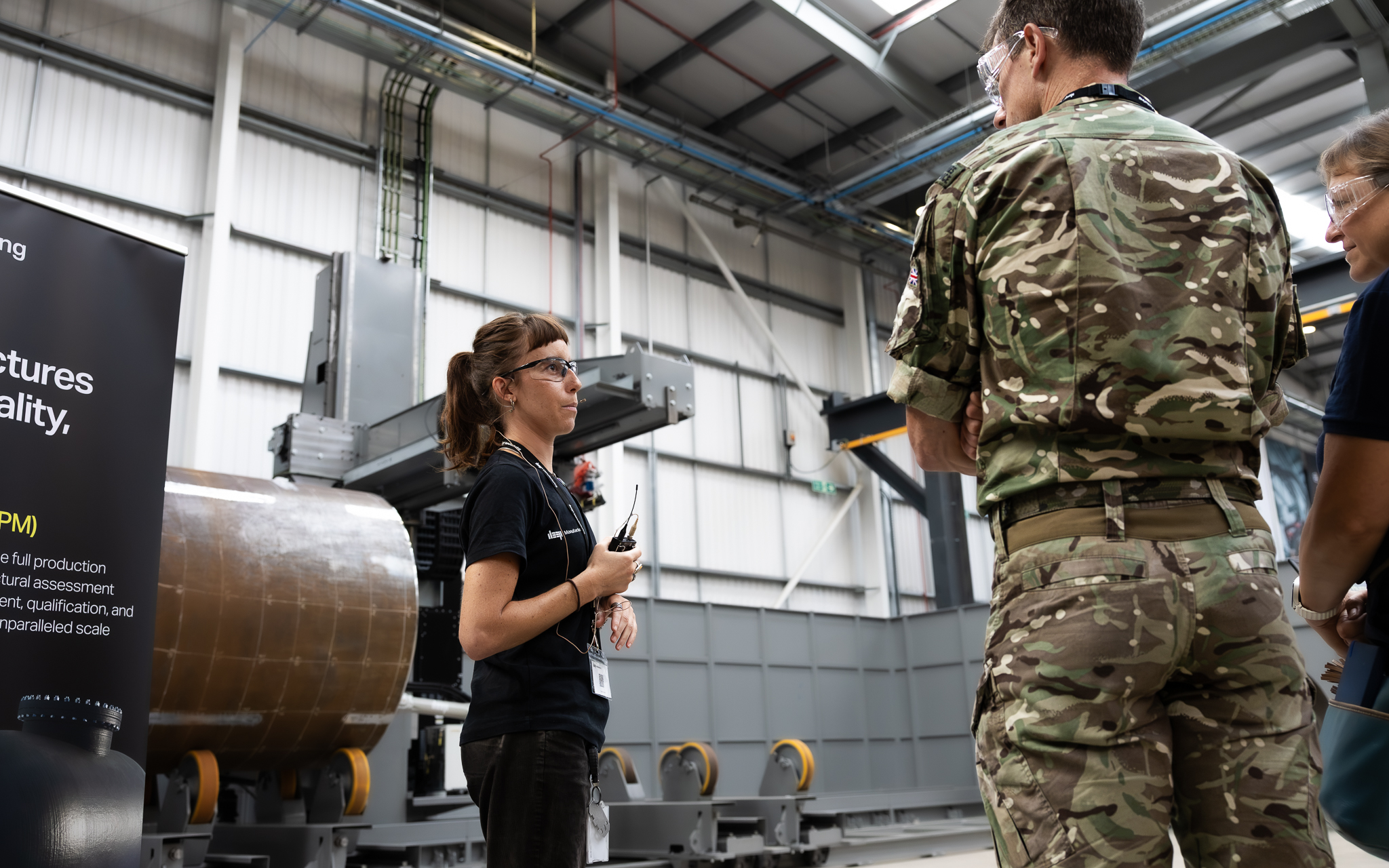
Featured image shows DEEP Manufacturing Marks 18 Months as World’s Only Fully DNV-Approved WAAM Producer for Pressure Vessels. Photo via DEEP Manufacturing.