

Spend less time fixing files. Discover smarter workflows at AMA Software 2026.
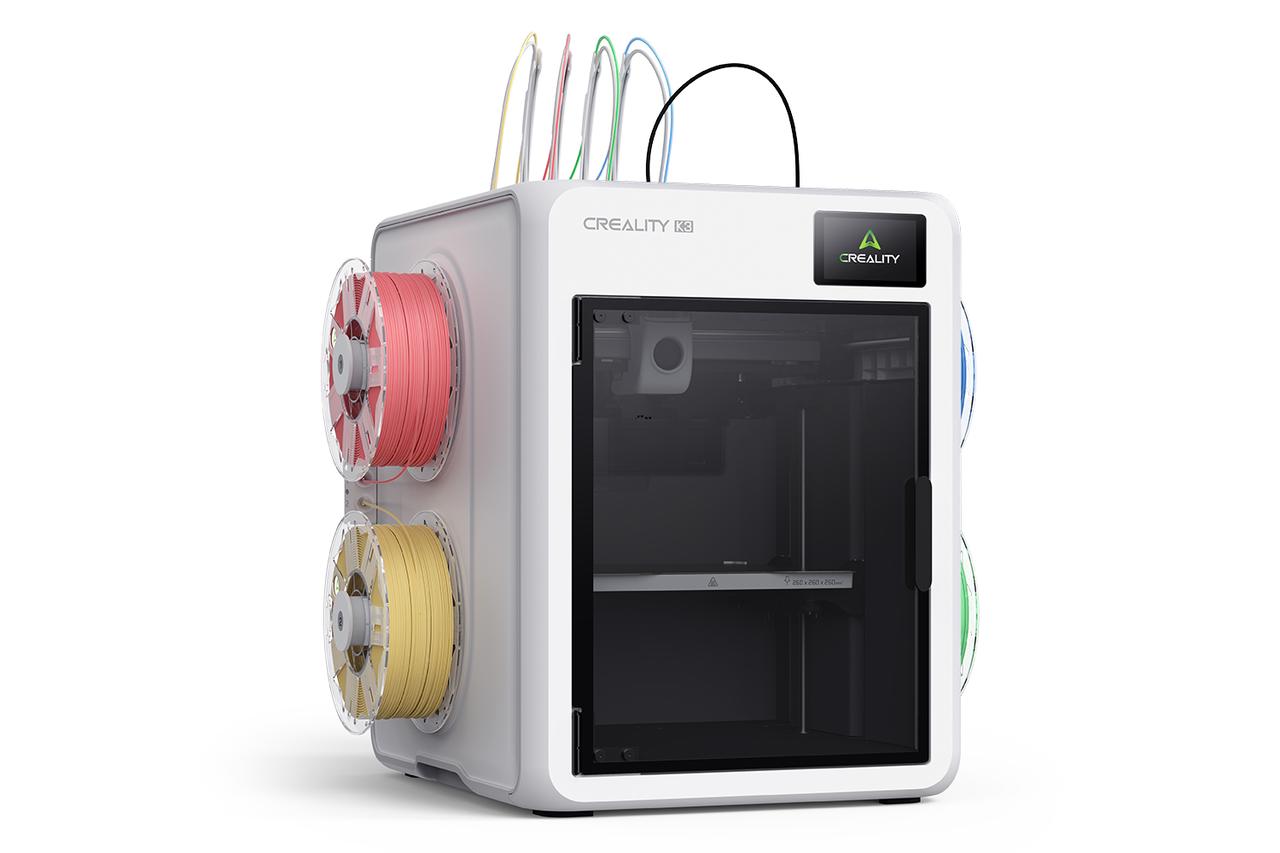
Creality has opened U.S. pre-orders for the K3, the newest printer in its K Series, with prices starting at $849. The machine is built around KliTek, a four-nozzle system designed to shorten color changes and reduce the filament lost to purging during multi-color printing.
The K3 combines four independent filament channels, swappable nozzle assemblies and 37 sensors within a system with a 260 × 260 × 260 mm build volume. Optional accessories extend it to mixed nozzle sizes, flexible TPU, and engineering-grade and soluble filaments.
Creality says the K3 builds on the automation and performance of its K2 Series. It targets a drawback of traditional single-nozzle multi-color printing, where every color change requires retracting, reloading and purging filament. Compared with conventional single-nozzle multi-color workflows, the company reports up to 80% shorter total print times and up to 85% less material waste, based on internal testing. The K3 was named an IFA Innovation Awards 2026 Honoree, and European availability is expected in December 2026.
Four-nozzle color switching
A single-nozzle multi-color print can involve hundreds or thousands of filament changes, each adding time and purged material. The K3 keeps four filaments loaded in separate channels and moves between lightweight nozzle assemblies, with each swap taking about five seconds.
According to Creality, a full material change takes under 15 seconds, and color switching runs up to five times faster than in conventional workflows. The nozzle assemblies use a USB-C quick-swap design, which the company estimates lowers replacement costs by up to one-third compared with replacing a complete toolhead.

Mixed nozzles, TPU and color blending
With optional accessories, users can run 0.2, 0.4, 0.6 and 0.8 mm nozzles within a single print, assigning finer nozzles to detailed surfaces and wider ones to infill. Creality puts the resulting efficiency gain at up to 30%.
For flexible filaments, an S-Drive dual-drive feeder handles TPU from 85A to 95A when paired with compatible accessories. Flow rates reach up to 15 mm³/s with TPU 95A, which Creality puts at seven times what standard consumer 3D printers achieve under specified testing conditions.
The K3 also supports CMYK color blending, layering calibrated translucent filaments to produce a wider range of colors. Supported materials include PLA, PETG, PET and PCTG. Accessories sold separately extend compatibility to engineering-grade, flexible and soluble filaments.

Speed, sensors and repeatability
The printer reaches speeds of up to 500 mm/s and acceleration of 20,000 mm/s², with a 300°C hot end and a 100°C heated bed. To keep nozzles aligned during rapid changes, it carries 37 sensors, 12 of which monitor nozzle alignment and locking.
In Creality’s lab tests, repeatability stayed below 25 μm across more than 800,000 nozzle-change cycles. Based on internal testing, the company also cites 30% greater rigidity from a reinforced structure and a 7 dB reduction in operating noise.
Swapping nozzles to cut purge waste
Snapmaker applied a related approach with the U1, a Kickstarter-launched printer with four independent print heads, each configured for a specific material or color. The U1 switches heads automatically during a job without purge towers, and Snapmaker reported an 80% cut in material waste during filament transitions. Like the K3, it gives each of four filaments a dedicated path to reduce purging.
Bambu Lab addressed the purge problem with the H2C, built around the Vortek Hotend Change System. Vortek uses six interchangeable, contactless hotends with inductive heating that warms up in eight seconds. Each hotend can be assigned a specific filament, which removes purge-cleaning cycles in jobs with fewer than seven filaments. This links the H2C to the K3’s per-filament nozzle logic. The H2C carries more hotends, connects to Bambu Lab’s AMS for up to 24 filaments, and was priced from €2,249 for the H2C AMS Combo.
At $849, the K3 brings per-filament nozzle swapping to a four-nozzle machine, with accessory-based support for mixed nozzle sizes and TPU.
Creality K3 technical specifications
As a promotion, customers who buy the K3 at $849 between October 12 and November 30, 2026 receive four rolls of Hyper PLA filament at no extra cost. Orders placed through Creality’s online store during that period also ship free.
| Specification | Creality K3 |
| Build volume | 260 × 260 × 260 mm |
| Maximum print speed | 500 mm/s |
| Acceleration | 20,000 mm/s² |
| Hot end temperature | Up to 300°C |
| Bed temperature | Up to 100°C |
| Nozzle system | KliTek four-nozzle system |
| Nozzle swap time | Approx. 5 seconds |
| Material change time | Under 15 seconds |
| Supported nozzle sizes | 0.2, 0.4, 0.6, 0.8 mm (optional accessories) |
| Flexible filament support | TPU 85A–95A via S-Drive dual-drive feeder (compatible accessories required) |
| Sensors | 37 (12 for nozzle alignment and locking) |
| Repeatability | Under 25 μm over 800,000+ nozzle-change cycles (internal testing) |
| Supported materials | PLA, PETG, PET, PCTG; engineering-grade, flexible and soluble filaments with optional accessories |
| Price (U.S.) | From $849 |
| European availability | Expected December 2026 |
Register now for AMA: Software 2026. Join 3D Printing Industry on 22 October for expert presentations, panel discussions and live audience Q&A exploring the software shaping additive manufacturing. Register here.
To stay up to date with the latest 3D printing news, don’t forget to subscribe to the 3D Printing Industry newsletter or follow us on LinkedIn.
Explore the full Future of 3D Printing and Executive Survey series from 3D Printing Industry, featuring perspectives from CEOs, engineers, and industry leaders on the industrialization of additive manufacturing, 3D printing industry trends 2026, qualification, supply chains, and additive manufacturing industry analysis.







