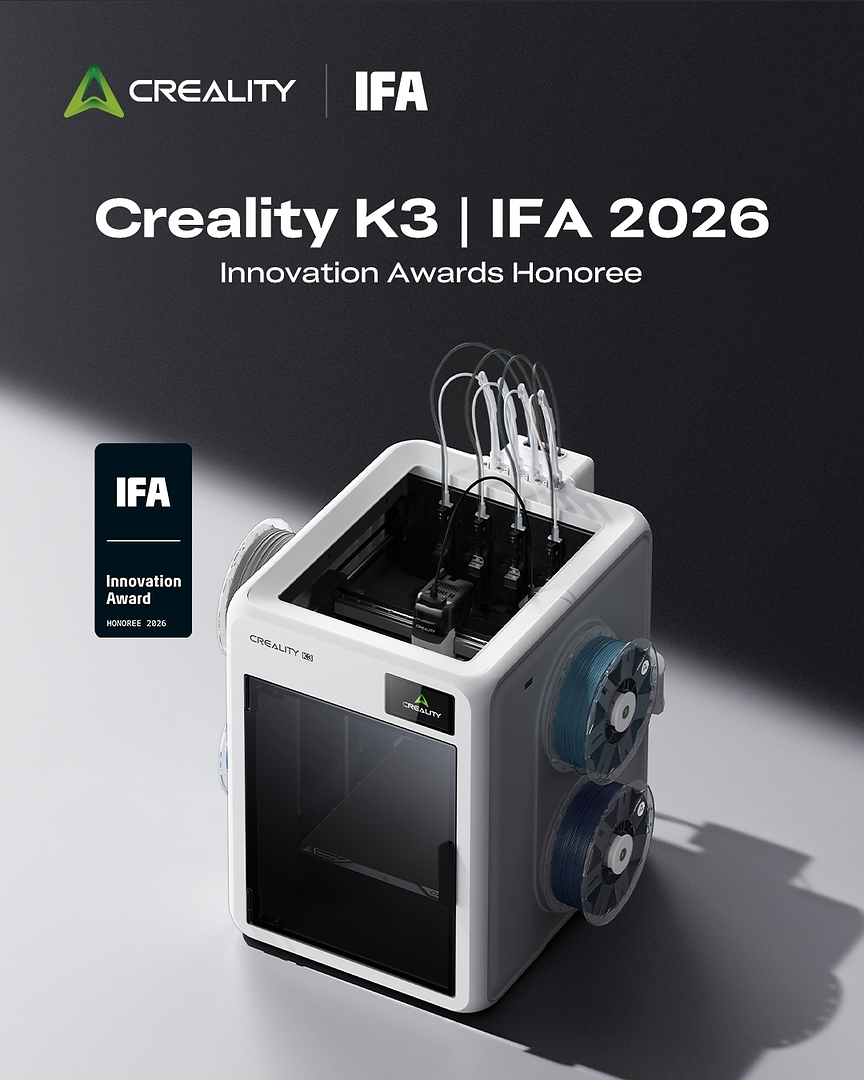
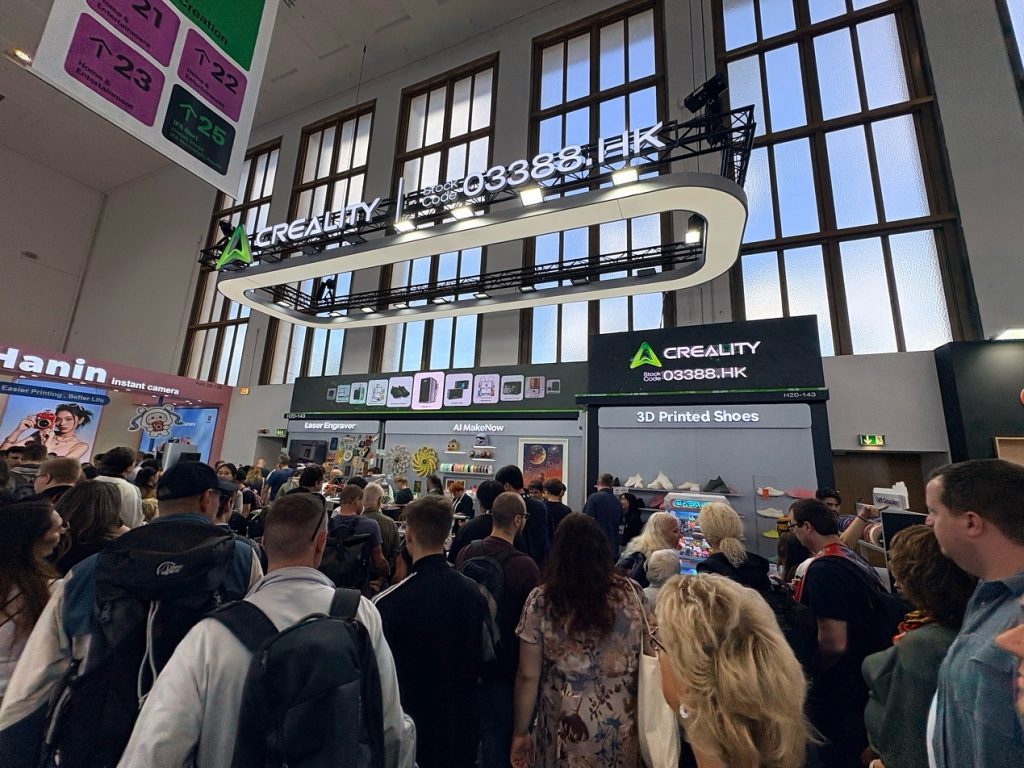
Creality introduced a new lineup of 3D printing and digital fabrication products at IFA 2026 in Berlin, spanning multicolor printing, filament recycling, resin printing, 3D scanning, laser processing, and 3D printed footwear. The lineup reflects Creality’s push to expand beyond desktop 3D printers into a broader ecosystem covering material recycling, digital scanning, and finished consumer products.
Two products from the lineup received recognition from the IFA Innovation Awards 2026: the M1 Filament Maker was named a Winner, and the K3 was named an Honoree.
K3: Multi-Channel Nozzle System
The K3 uses a built-in system called KliTek that the company says swaps nozzles in 4.8 seconds, removing the repeated filament retraction, reloading, and purging steps typically required by single-nozzle multicolor printers. Creality states this cuts total print time by up to 80 percent and material waste by up to 85 percent, based on internal testing.
With additional accessories, the printer can process soft, flexible filaments in the TPU 85A–95A range and combine materials of different hardness within a single build. It also supports pairing a 0.4 mm nozzle for outer walls with a 0.8 mm nozzle for infill, which Creality says increases print efficiency by up to 30 percent.
SPARKX i8 and M1 Filament Recycling
The SPARKX i8 is built around a four-channel toolhead and a 4-in-1 hotend that keep four filaments loaded at once. A shorter shared melt zone is intended to reduce purging and transition time between colors during four-color prints.
The M1 Filament Maker, used together with the R1 Shredder, lets users process plastic waste and failed prints into new filament, including custom material blends.
Additional Printers and Peripherals
Creality also expanded its FDM range with the Ender-3 V3 Mega, which has a 420 × 420 × 420 mm build volume and supports 85A–95A TPU for large-format and batch production.
Two new resin printers were introduced: the HALOT-X1 Neo, a compact model with high-resolution printing and AI-assisted features, and the HALOT-X1 Max, which combines a 17.1 L build volume, a 16K display, 40°C active heating, a quad-lead-screw structure, and a 5 L resin system for continuous production.
The Pika 3D scanner uses a seven-line blue laser and near-infrared scanning in a 260 g portable body, with accuracy to 0.03 mm and scan speeds up to 110 fps, plus wireless connectivity. Creality also showed its latest A1C and T1C laser systems for engraving, cutting, and marking.
Separately, Creality’s Nexbie footwear line, including the CloudWing, CloudSpark, and CloudX models, uses DLP printing and digitally engineered structures to produce 3D printed shoes.
Nozzle-Swapping as an Alternative to Purge-Based Multicolor Printing
Creality’s approach with the K3 reflects a broader strategy in multicolor 3D printing: replacing single-nozzle filament switching, which requires retraction, reloading, and purging between colors, with a mechanism that swaps hardware components instead. The K3’s KliTek system swaps nozzles in 4.8 seconds, targeting the waste and time overhead that purge-based systems generate.
Snapmaker‘s U1 pursues this strategy through four independent, preloaded toolheads that swap in about five seconds via its SnapSwap system, which the company says cuts filament waste by up to 80 percent compared with purge-tower methods. Like the K3, the U1 avoids purging between color changes by keeping each material on dedicated hardware, though it uses complete toolhead swaps rather than a nozzle-only exchange.
Bambu Lab‘s H2C takes a related approach with its Vortek system, which swaps between six interchangeable, contactless hotends to print up to seven materials without purge-cleaning the nozzles. As with the K3, the goal is eliminating purge waste through hardware switching rather than slicer-level adjustments, though the H2C’s hotends connect and heat inductively rather than through the nozzle-only swap Creality describes for the K3.
Across these systems, hardware-based swapping has become the primary route manufacturers are taking to cut multicolor print waste.
3D Printing Industry is inviting speakers for its 2026 Additive Manufacturing Applications (AMA) series, covering Energy, Healthcare, Automotive and Mobility, Aerospace, Space and Defense, and Software. Each online event focuses on real production deployments, qualification, and supply chain integration. Practitioners interested in contributing can complete the call for speakers form here.
To stay up to date with the latest 3D printing news, don’t forget to subscribe to the 3D Printing Industry newsletter or follow us on LinkedIn.
Explore the full Future of 3D Printing and Executive Survey series from 3D Printing Industry, featuring perspectives from CEOs, engineers, and industry leaders on the industrialization of additive manufacturing, 3D printing industry trends 2026, qualification, supply chains, and additive manufacturing industry analysis.
Featured image shows Creality K3 | IFA 2026. Image via Creality K3.