

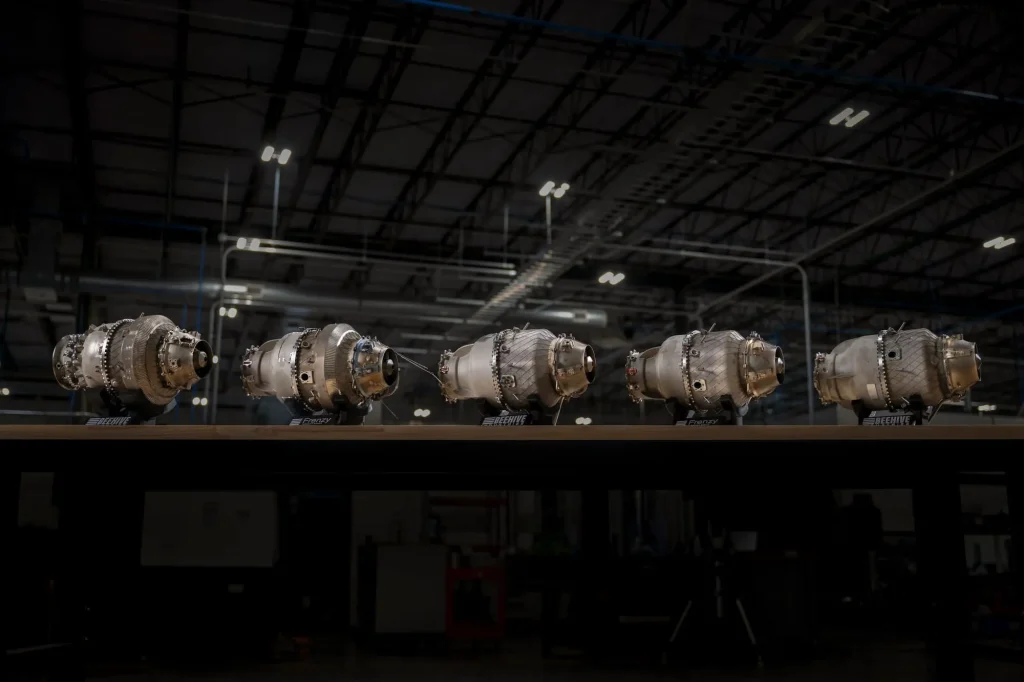
Denver-based propulsion maker Beehive Industries has completed the first engine test of its Frenzy 6 prototype, a 100 lbf turbojet for small munitions, drones and uncrewed aerial vehicles (UAVs). The engine went from finalized U.S. Air Force requirements to a completed test in four months. The company says the timeline shows its additively enabled engineering approach can turn a written specification into running hardware in a fraction of the usual time.
Beehive first fired the engine on September 23 at its headquarters in Colorado. Beehive funded the prototype itself, and it met all of its initial test objectives: reliable starting, engine performance and operability. During an early run in September, the prototype, which Beehive calls its Zero Engine to Test (ZETT), spun up to 80,000 RPM.

A smaller engine built on Frenzy 8
Frenzy 6 is the second member of Beehive’s Frenzy family. It follows the 200 lbf Frenzy 8, which the company has been maturing over the past year. The smaller engine reuses Frenzy 8’s design principles and the lessons from developing it. The aim is a lower-thrust propulsion system for platforms that need affordable power that can be produced in volume.
The program sits within a larger Air Force relationship. In April, Beehive announced a $29.7 million U.S. Air Force contract to advance development of the Frenzy engine family. The Frenzy 6 requirements were finalized with the same Air Force customer, which set the four-month clock running.
David Kimball, Chief Technology Officer at Beehive Industries, said the earlier program made the faster turnaround possible. “Frenzy 8 validated how we design and scale a concept at unprecedented speed, and the learnings from that program have enabled us to iterate even faster on Frenzy 6 while introducing new technology in a cost-competitive product that is entirely U.S.-designed and built,” he said.
Kimball added that Beehive expects Frenzy 8’s performance and its ability to start at altitude to carry over to the smaller engine. He credited the four-month timeline to additive manufacturing and to experience gained across the Frenzy portfolio.
Earlier this year, high-altitude tests of Frenzy 8 at a government facility in Ohio confirmed reliable performance across its full operating range, and Beehive then moved to scale production to meet growing demand. Frenzy 6 is starting from that base rather than from a clean sheet.
Sizing propulsion for affordable mass
Beehive presents Frenzy 6 as a way to extend its engine family down to smaller platforms. Gordie Follin, Chief Product Officer at Beehive Industries, described the engine as packaging Frenzy 8’s strengths into a smaller form factor for smaller munitions, drones and UAVs.
“We are focused on helping to enable affordable mass for U.S. defense, and this is the latest example of our commitment to do that across all relevant platforms,” Follin said.
Follin also pointed to Beehive’s willingness to invest ahead of contracts. The company paid for the Frenzy 6 prototype itself rather than waiting for a funded development program. He said the additively enabled approach gives Beehive advantages in meeting customer demands for speed, performance, cost and scale.
The Frenzy family was designed from the start for scalable production, in applications where affordability, performance and rapid availability matter most. Beehive describes the Frenzy 6 test as the latest step in its broader effort to shorten propulsion development and move new engine designs into production quickly.
Production capacity and next steps
The test lands alongside a broader manufacturing build-out. Beehive has announced plans to build capacity for more than 8,000 jet engines a year. That build-out is supported by investment in additive manufacturing technology, precision machining and expanded production facilities. Frenzy 6 is designed to run through that same production system and share it with Frenzy 8.
With initial testing complete, Beehive will continue testing Frenzy 6 and shift its focus to integrating the engine into a vehicle. The program is targeting a flight demonstration in 2027.
Beehive’s progress comes as other propulsion developers use additive manufacturing to compress engine timelines for expendable systems. Pratt & Whitney has tested its TJ150 with nearly 60% additively manufactured content, consolidating more than 50 hot-section components into a handful of printed parts. In the UK, the Ministry of Defence and Alloyed took a new turbojet from concept to flight in under seven months as part of a program to build domestic, rapidly scalable propulsion capability.
Against those benchmarks, a four-month run from requirements to a tested engine puts Frenzy 6 among the fastest programs in the small-turbojet segment. The next test is whether it keeps that pace through vehicle integration and into flight.
To stay up to date with the latest 3D printing news, don’t forget to subscribe to the 3D Printing Industry newsletter or follow us on LinkedIn.
Explore the full Future of 3D Printing and Executive Survey series from 3D Printing Industry, featuring perspectives from CEOs, engineers, and industry leaders on the industrialization of additive manufacturing, 3D printing industry trends 2026, qualification, supply chains, and additive manufacturing industry analysis.
Featured image shows Frenzy 6 Prototype. Photo via Beehive Industries.







