

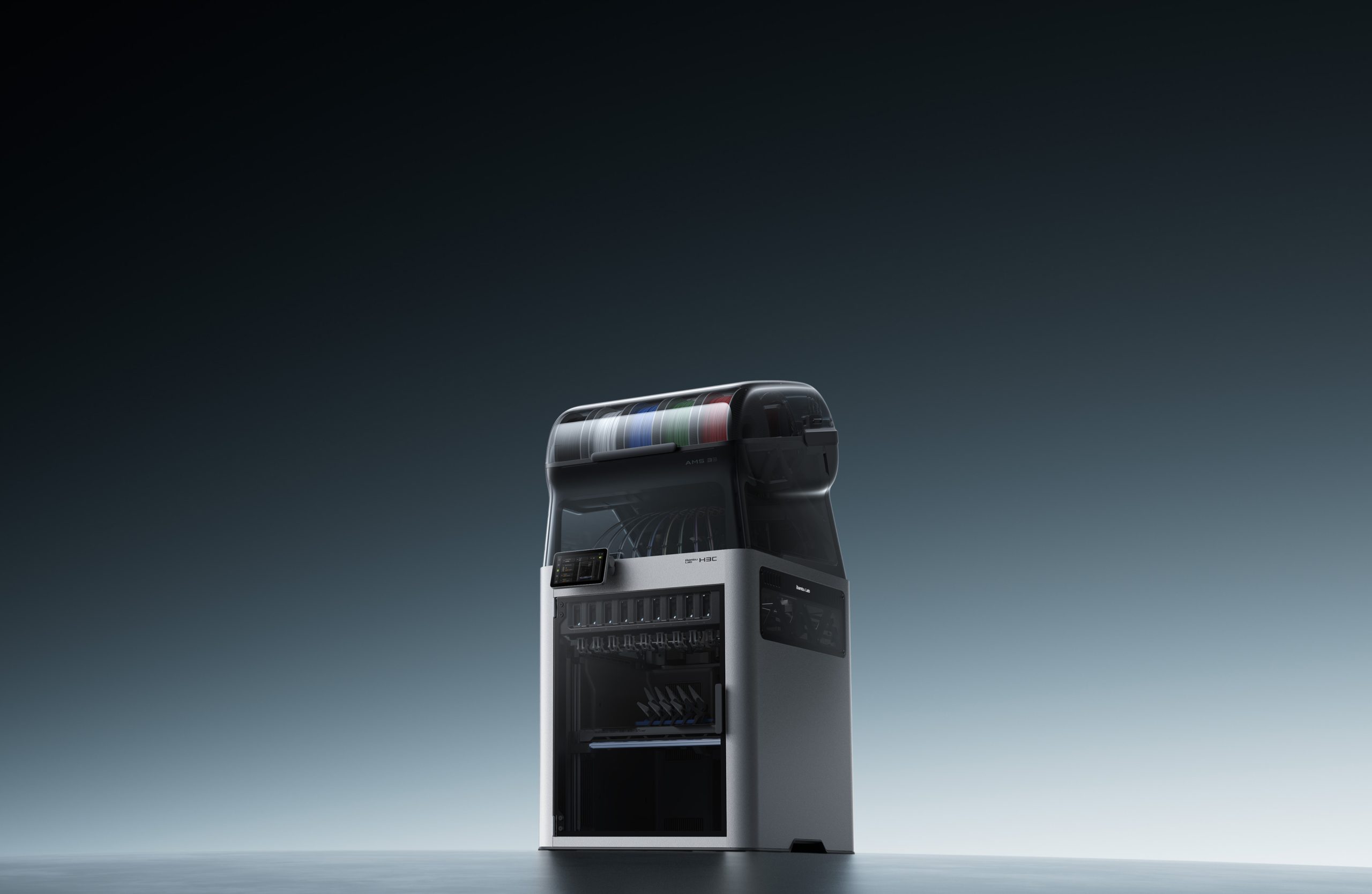
Chinese 3D printer manufacturer Bambu Lab has launched the H3C, its first third-generation desktop 3D printer, priced at US$2,499. The printer is built around Swaptek, a nine-tool changer. Every tool stays loaded with filament and pre-heated, so the machine can switch materials in under six seconds. Bambu Lab calls the H3C the world’s first nine-tool desktop 3D printer. The AMS Combo version costs US$2,499 excluding tax with shipping included, or €2,499 including tax in Europe. It is available from November 3 through the Bambu Lab Official Store.
According to Bambu Lab, the H3C solves a problem its earlier machines left open. The X1 and P1 series, released in 2022, simplified calibration for multi-colour printing. Changing between several filaments during one job, however, was still slow and labour-intensive. The H3C is the company’s first printer designed from the start around a dedicated tool changer. It fits nine tools, a flexible-material extruder and integrated filament management into a footprint no larger than a single-spool A-Series printer.
How Swaptek changes tools
Conventional single-head printers unload one filament and load the next at every change. In the Swaptek system, each tool has its own filament path and heating element, so its material is always ready to print. A feature called Active Pre-Heat reads the upcoming G-code and starts heating the next nozzle while the current tool finishes its segment. When the mechanical swap happens, the new nozzle is already at temperature. A short priming sequence then returns fresh filament to the model with minimal waste.
A Retractable Rack folds the guide tubes back during printing. This keeps the part visible, reduces vibration, frees Z-axis height for taller builds, and stops the tubes from hitting each other on long multi-material jobs. The printer also handles automatic docking, tool-offset compensation and full bed levelling before each print. Bambu Lab says this keeps the added complexity inside the machine rather than in the user’s workflow.

Flexible filaments and filament management
The new FlexFeed extruder accepts both 1.75 mm and 2.85 mm filament and switches between them on the fly. Its dedicated 2.85 mm path for TPU keeps soft filament rigid under pressure. According to the company, this allows flow rates up to three times those of a classic printer and reliable printing of TPU as soft as 75A. Bambu Lab sees uses in printed footwear, comfortable wearables, flexible hinges and soft robotics, which previously required specialist hardware.
All nine spools sit in the AMS 3H, a sealed, airtight chamber that protects filament from moisture and reads material types via RFID. Filament feeds automatically to the right tool, and dedicated TPU inlets draw flexible material directly from the unit. A built-in drying module reaches 85°C while printing continues, which supports engineering polymers such as PA, PC and carbon-fibre blends. Connecting an original AMS to tool 1 expands capacity to 24 materials, and optional AMS 2 Pro and AMS HT units add more drying capacity.
Motion and thermal hardware
The H3C’s motion platform is 40% lighter than its predecessor’s. It reaches accelerations of 25,000 mm/s² and speeds of up to 1,400 mm/s, and Bambu Lab says it does so without the ringing usually seen at these speeds. Nozzles range from 0.2 mm to 0.8 mm and are made of fully hardened steel rated HRC 55+ for abrasive carbon-fibre, glass-fibre and other composite filaments.
The build chamber heats to 65°C, and each of the nine tools can reach 350°C, covering materials such as ABS, PC, PA-CF and PET-CF. Cooling comes from four layers: a CFD-engineered part-cooling fan, two side-chamber fans, a dedicated tool-head fan, and a rear chamber fan that regulates overall build-space temperature.
What faster tool changes enable
Because colour changes are now quick, users can blend shades during printing. Bambu Lab says near-full-wheel gradients are possible from five base filaments. Its PLA Palette pairs opaque cyan, magenta and yellow bases with white and one translucent black. The opaque bases use the PLA Basic formulation and let through less than 1% of light at a 2 mm wall.
A single job can also combine nozzle sizes. For example, a 0.2 mm nozzle can handle fine detail, a 0.4 mm nozzle the bulk of the part, and a 2.85 mm path a soft TPU strap. Users can likewise place ultra-soft TPU, rigid engineering polymers and dissolvable supports in one component. The company says this could produce lighter footwear and more ergonomic bags in one pass.
Optional accessories include a Bird-eye camera for monitoring from a second viewpoint, the Bambu Station stand with storage, and the E1 Air Purifier. The purifier starts filtering automatically when a print begins and captures VOCs, PM2.5, ultrafine particles and micro-plastics.

Technical specifications and pricing
The H3C AMS Combo is available from November 3 through the Bambu Lab Official Store. The table below lists the main specifications and price of the H3C and its AMS 3H filament system.
| Specification | Bambu Lab H3C |
| Printing technology | Fused filament fabrication (FFF) |
| Build volume (W × D × H) | 330 × 320 × 325 mm³ |
| Enclosure | Enclosed |
| Tool-change system | Bambu Lab Swaptek™ 9-tool changer |
| Chassis / outer frame | Steel / plastic |
| Product dimensions | 493 × 571 × 587 mm |
| Recommended installation space | 593 × 1,056 × 1,306 mm |
| Net weight | 36.28 kg (including AMS 3H) |
| Nozzle material | Hardened steel |
| Included nozzle | 0.4 mm |
| Supported nozzle sizes | 0.2, 0.4, 0.6, 0.8 mm |
| Max nozzle temperature | 350 °C |
| Filament diameter | 1.75 mm; 2.85 mm (bypass feed only) |
| Extruder gear / motor | Hardened steel / Bambu Lab high-precision brushless servo motor with planetary gear |
| Filament cutter | Integrated in the print tool |
| Expansion options | Compatible with creation tools (cutting tool, drawing tool, more coming) |
| Build plate | Flexible steel plate; Textured PEI plate included |
| Compatible build plates | Textured PEI, SuperTack Cool Plate, Engineering Plate |
| Max bed temperature | 120 °C |
| Max toolhead speed | 1,400 mm/s |
| Max toolhead acceleration | 25,000 mm/s² |
| Max hotend flow | 40 mm³/s (Bambu Lab ABS, 280 °C) |
| Active chamber heating | Yes, up to 65 °C |
| Air filtration | H11 HEPA filter; granular coconut-shell activated carbon |
| Cooling | Closed-loop control on all fans |
| Compatible filaments | PLA, PETG, PCTG, TPU, EVA, PE, PP, PHA, PVA, BVOH, support filament, ABS, ASA, HIPS, PA, PAHT, PC, PET, PPA, PPS, and carbon/glass-fibre-reinforced variants |
| Cameras | Live camera and toolhead camera, 1920 × 1080; optional Bird-eye camera, 3264 × 2448 |
| Sensors | Door, filament run-out, nozzle clumping, filament odometry, power-loss recovery |
| Max power | 2,250 W at 220 V; 1,850 W at 110 V |
| Low-power mode | 1,050 W |
| Operating temperature | 10–30 °C |
| Touchscreen | 5-inch, 854 × 480 |
| Storage | 64 GB built-in eMMC and USB port |
| Processors | Single-core Cortex-M4 and Cortex-M7 motion controllers; quad-core ARM application processor with dedicated NPU |
| Slicer | Bambu Studio; third-party slicers exporting standard G-code supported, though some advanced features may not work |
| Connectivity | Wi-Fi 6 (no Ethernet) |
| AMS 3H spool capacity | 9 |
| AMS 3H dimensions / weight | 480 × 562 × 460 mm / 9 kg |
| AMS 3H drying | Up to 85 °C; dries 2 spools at once; active moisture discharge; sealed storage |
| AMS 3H filament ID | RFID |
| AMS 3H power | 200 W max; 70 W steady state |
| Price (H3C AMS Combo) | US$2,499 (excl. tax, incl. shipping); €2,499 (incl. tax) |
To stay up to date with the latest 3D printing news, don’t forget to subscribe to the 3D Printing Industry newsletter or follow us on LinkedIn.
Explore the full Future of 3D Printing and Executive Survey series from 3D Printing Industry, featuring perspectives from CEOs, engineers, and industry leaders on the industrialization of additive manufacturing, 3D printing industry trends 2026, qualification, supply chains, and additive manufacturing industry analysis.
Featured image shows the H3C Main Product. Photo via Bambu Lab.







