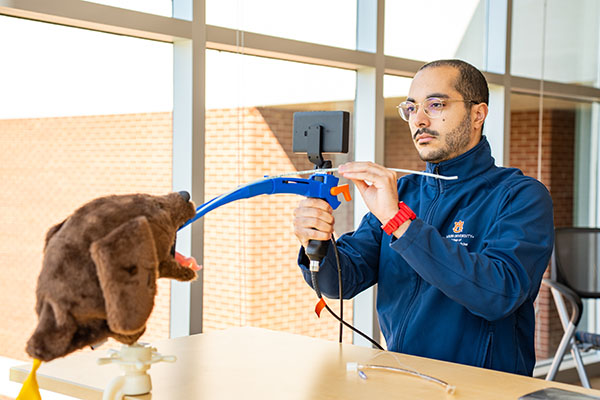
A team spanning Auburn University‘s College of Veterinary Medicine and Samuel Ginn College of Engineering has developed a 3D printed, camera-equipped laryngoscope designed to help veterinary students learn to intubate large animals like goats and pigs. The device, which costs about $150 to produce, displays the procedure in real time on a screen, addressing a training gap that has long made it difficult for groups of students to observe intubation on animals with small mouths and airways.
The project grew out of a practical problem in the classroom rather than a formal research initiative, and moved from a homemade prototype to a finished device over roughly a year of collaboration between veterinary staff and engineering students.
A borescope camera and a continuing-education deadline
The idea began with veterinary technician Katie Ray, who has guided hundreds of students through their first large-animal intubations using traditional metal laryngoscopes. Having seen video laryngoscopes improve visibility in human medicine, she wondered whether something similar could help veterinary students, but found no equivalent product for ruminants on the market. Needing footage for a continuing-education presentation, Ray bought a $30 borescope camera, connected it to her phone, and used it alongside a standard laryngoscope to film an intubation, a workaround that worked well enough that she began using it regularly in labs.
Anesthesia resident Dr. Nassim Bouhabib joined the effort and modified the setup by attaching the camera directly to the laryngoscope itself. That refinement convinced Ray and Bouhabib the concept was worth developing properly, and they brought in the College of Engineering to build a device suited specifically to their needs.
Building the device in the ME3D Lab
The veterinary team partnered with mechanical engineering students Will Jones and Cooper Rice in the college’s Mechanical Polymer Additive Manufacturing (ME3D) Laboratory to turn the concept into a working tool. For Jones, a senior who has worked in the lab for three years, the project offered early exposure to a real client with real constraints: “Getting to do that in the stage that we are in our education was very helpful because it gives us a taste of what things will be like in the future,” he said.
Development ran through multiple design iterations, with Jones and Rice visiting Auburn’s veterinary campus to watch the tool in use, gather feedback from instructors, and refine successive versions. Rice, who graduated in May 2026, said the project was among the highlights of his time in the lab, and used it to build skills in new modeling techniques, CAD functions, and 3D printing materials. ME3D Director Jordan Roberts framed the collaboration as mutually beneficial, giving engineering students exposure to a field “very much outside of our normal areas of practice” while working alongside experienced veterinary practitioners.
A $150 teaching tool built for visual learners
The finished device features a lever-controlled camera that lets users adjust the viewing angle for a clearer look at the airway, a large display screen showing the intubation in real time, and an adjustable blade that accommodates animals of different sizes, all built for roughly $150.
Students still learn the underlying technique on traditional laryngoscopes, but Ray sees the camera-equipped version as a complement rather than a replacement: “If you’re a visual learner — and a lot of our students are — this tool gives them something they can see rather than us just explaining it.”
The team has submitted a paper for publication that will include the files needed to 3D print the device, which would let other veterinary programs replicate the low-cost tool once it’s published. Ray, who helped move the idea from concept through funding, development, and publication, pointed to the project as evidence that veterinary technicians can play a larger role in research: “There’s definitely room for more veterinary technicians to be involved in research.”
A Recurring Fix for Medical Education’s Cost Problem
Auburn’s laryngoscope tackles a gap that keeps resurfacing across medical and veterinary training: commercial simulators and task trainers are often too expensive or too generic for programs to buy in bulk, pushing schools to build cheaper, purpose-built versions in-house whenever a specific teaching need isn’t served by the market.
Other university teams have taken the same route toward the same goal. Engineering students at the University of Alabama built a set of nursing task trainers, including a cricothyrotomy trainer, vein finder, and onychectomy trainer, using open-source design files that cost just $6, explicitly asking “how cheaply can we do this?” before publishing the files on Thingiverse for other programs to use.
More recently, Masaryk University’s Simulation Centre launched a free 3D anatomy portal after finding that commercial suppliers couldn’t provide a simulator suited to their teaching needs, building their own instead at a fraction of the typical cost.

Auburn’s project follows that same in-house, publish-it-forward pattern, just applied to a corner of veterinary training, large-animal intubation, that had no dedicated commercial tool at all.
3D Printing Industry is inviting speakers for its 2026 Additive Manufacturing Applications (AMA) series, covering Energy, Healthcare, Automotive and Mobility, Aerospace, Space and Defense, and Software. Each online event focuses on real production deployments, qualification, and supply chain integration. Practitioners interested in contributing can complete the call for speakers form here.
To stay up to date with the latest 3D printing news, don’t forget to subscribe to the 3D Printing Industry newsletter or follow us on LinkedIn.
Explore the full Future of 3D Printing and Executive Survey series from 3D Printing Industry, featuring perspectives from CEOs, engineers, and industry leaders on the industrialization of additive manufacturing, 3D printing industry trends 2026, qualification, supply chains, and additive manufacturing industry analysis.
Featured image shows 3D Prints Low-Cost Camera Laryngoscope. Photo via Auburn University.