University of Mississippi researchers have entered a new agreement with pharmaceutical ingredient company Colorcon to build an artificial intelligence-powered database designed to help pharmacies and drug manufacturers produce personalized, 3D printed medications. The project is led by Mo Maniruzzaman, chair and professor of pharmaceutics and drug delivery at Ole Miss, whose lab will develop a learning algorithm that matches the right combination of ingredients for each drug a pharmacy wants to print.
“Essentially, we’re creating a bank of information, a reference book for drug manufacturing,” Maniruzzaman said. He expects the resulting AI database to have uses well beyond Colorcon: “Creating this AI database will be really useful – not just for Colorcon – but for similar companies and even pharma giants,” he said, adding that other companies “could easily adopt this kind of platform for their own discovery pipeline and leverage our findings to solve problems.”
Matching the right ingredients for every drug
Every medication is built from two categories of ingredients: active compounds, such as the acetaminophen in a pain reliever, and inactive ingredients, known as excipients, which include the binders, fillers, coloring agents and coatings that hold a pill together.
Not every excipient is compatible with every active ingredient, so each time a new drug formulation is manufactured, researchers have to verify that none of its components will interfere with one another. That verification process is one of the core problems Maniruzzaman’s lab is trying to solve with AI: rather than testing combinations by hand, the algorithm would be trained to pair the correct excipients with whatever active ingredient a pharmacy needs to print.
Kshitij Chitnis, a third-year doctoral student in pharmaceutics and drug delivery in Maniruzzaman’s lab, framed the underlying problem in terms of how medication is currently made. “The problem with the conventional dosage form is that the conventional dosage forms are not personalized to the patient,” he said, adding that producing individualized drugs through traditional manufacturing is impractical at scale: “It would be a difficult thing for the industry to make personalized drugs traditionally.”
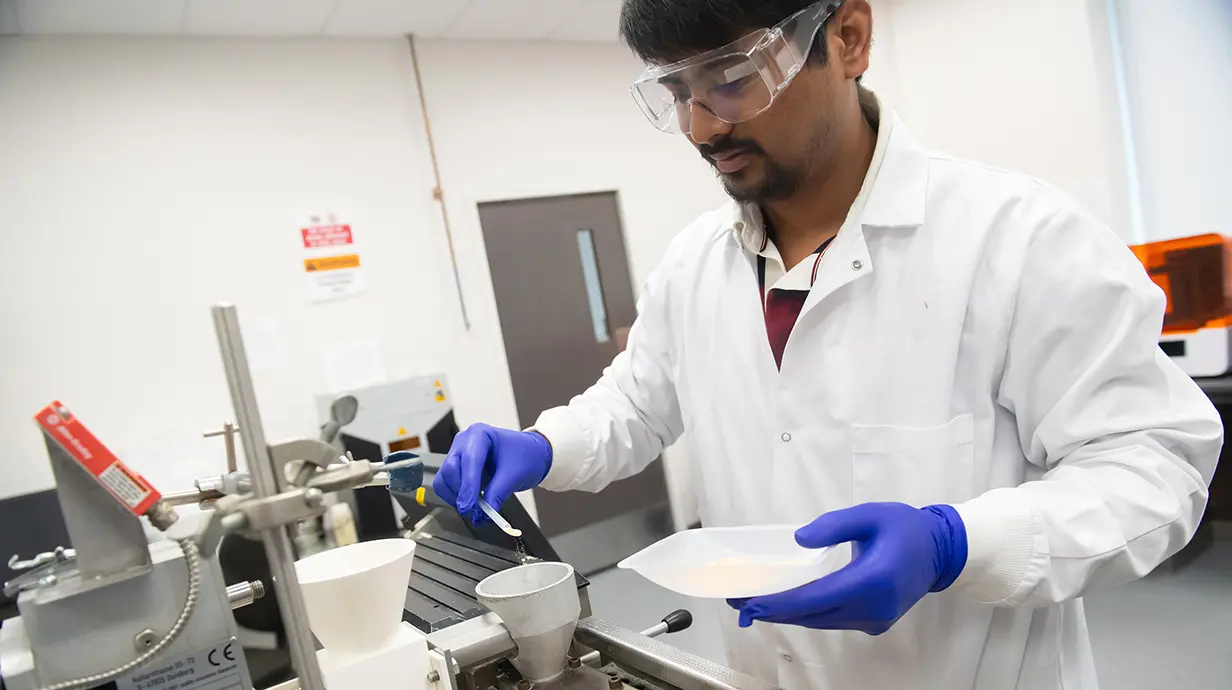
3D printing offers a workaround. In the lab, powdered drug ingredients are fed into an extruder, a machine that compresses the material into a filament that functions as the “ink” for a 3D printer. That filament can then be printed into tablets or capsules sized and dosed for an individual patient, a smaller pill for a child, for instance, or a capsule engineered to release its dose on a delayed timer.

Removing the training barrier for pharmacists
Even with the ingredient-matching problem solved, one of the biggest obstacles to bringing 3D printed medication into everyday pharmacy use is technical: pharmacists would need to learn how to operate 3D printers themselves. Sujith Bashetty, another third-year doctoral student in the lab, said an AI tool that automatically selects compatible excipients and instructs the printer directly would remove much of that burden. “Here we are paving the pathway for scalable and regulated 3D printed medication,” he said.
Bashetty pointed to industrial-grade excipients as the key to making the approach commercially viable. “If we successfully use industrial-grade excipients, we can reduce the burden of large scalability, and if we can print on-demand medication in pharmacies, that will save millions of dollars,” he said. He described the broader goal of the project in similar terms: “We are aiming to bridge the advanced manufacturing gap with scalable pharmaceutical development and enabling the future of personalized, high-performance drug delivery.”
If the database proves reliable, the researchers believe it could help move 3D printed medication out of specialized research settings and into routine use, letting pharmacies print custom-dosed drugs on demand rather than relying solely on standardized, mass-produced tablets and capsules.

The pharmacy-adoption gap in 3D printed medicine
The gap the Ole Miss project is targeting isn’t the printing itself, it’s getting pharmacists who aren’t trained printer operators to use the technology reliably and at scale. Maniruzzaman’s AI database addresses that specific bottleneck by handling the ingredient-matching decisions a pharmacist would otherwise need specialized training to make.
Other companies have approached that bottleneck from the hardware and materials side. FabRx published a study in February 2025 testing its M3DIMAKER printer for automated capsule filling in a community compounding pharmacy, finding it cut manual labor by 55% and overall preparation time by roughly 10% compared to traditional hand compounding.
Elsewhere, CurifyLabs raised a $14 million Series A in July 2026 to scale its GMP-certified “Pharma Inks,” which let pharmacists select from a pre-approved library of printable formulations rather than developing ingredient combinations themselves.
Where those efforts build guardrails into hardware or pre-approved materials, the Ole Miss project is trying to solve the same adoption problem at the decision-making layer, with an AI system standing in for the specialized knowledge a pharmacist would otherwise need.
3D Printing Industry is inviting speakers for its 2026 Additive Manufacturing Applications (AMA) series, covering Energy, Healthcare, Automotive and Mobility, Aerospace, Space and Defense, and Software. Each online event focuses on real production deployments, qualification, and supply chain integration. Practitioners interested in contributing can complete the call for speakers form here.
To stay up to date with the latest 3D printing news, don’t forget to subscribe to the 3D Printing Industry newsletter or follow us on LinkedIn.
Explore the full Future of 3D Printing and Executive Survey series from 3D Printing Industry, featuring perspectives from CEOs, engineers, and industry leaders on the industrialization of additive manufacturing, 3D printing industry trends 2026, qualification, supply chains, and additive manufacturing industry analysis.
Featured image shows The filament on the right is used in 3D printing to manufacture custom medication, such as the tablet on the left. Photo via Kevin Bain/Ole Miss Digital Imaging Services.