Australian metal additive manufacturing (AM) company AML3D has joined a three-year research and development (R&D) project that aims to qualify its Wire-Arc Additive Manufacturing (WAM) process for aerospace tooling production. The company is one of several industry and research participants, a group that includes a global aerospace prime whose name has not been disclosed. Together, the partners will contribute roughly AU$3.89 million.
The work targets a supply chain constraint in aerospace, where AML3D says tooling lead times can reach 24 months. Qualification would position the company as a potential supplier of aerospace tooling.
The prime is described as a contractor that manages the design, development, and production of large-scale aerospace systems, aircraft included. AML3D, which trades on the Australian Securities Exchange (ASX) under the code AL3, has not named the partner and said it does not consider the prime’s identity material to the price or value of its securities.
What AML3D Is Putting In
AML3D’s share of the budget comes to about AU$530,000 across the three years. Cash accounts for around AU$130,000 of that figure, while staff and other in-kind contributions make up the other AU$400,000.
The company has told investors it does not expect its participation to bring in revenue directly. Any future purchase orders or production contracts stemming from the work would be negotiated under separate commercial agreements.
Tackling Tooling Lead Times
WAM pairs welding and robotic automation with materials engineering and in-house software, and serves as the basis for AML3D’s ARCEMY industrial metal 3D printing systems.
According to CEO Sean Ebert, AML3D holds AS9100D aerospace quality management accreditation and has already shown that WAM can support aerospace work. “This new R&D project moves AML3D into a formal qualification pathway for [WAM] to be deployed for Aerospace tooling applications,” he said.
Ebert tied the qualification effort directly to delivery times. “It is expected AML3D’s [WAM] technology will be shown to dramatically reduce Aerospace tooling component manufacturing lead times compared to traditional manufacturing techniques,” he said.
Wire Arc and Large-Format Routes to Faster Aerospace Tooling
AML3D is addressing tooling lead times of up to 24 months by taking WAM through qualification for aerospace tooling production.
In a co-funded pilot, Italian aerospace tooling specialist Eligio Re Fraschini and Caracol tested WAM on a spar tool for carbon fiber lamination, shortening production time compared with conventional methods. The results align with AML3D’s expectation that WAM can reduce tooling lead times, though the pilot covered a single tool, with no formal qualification program or aerospace prime reported.
Caracol and French manufacturer Formes et Volumes also produced a polymer composite lamination tool for aerospace that cut lead time by 50% and is now in production use. It targets the lead time problem AML3D describes, but with a polymer process. AML3D’s metal process has yet to be qualified.
Where these projects measured gains on individual tools, AML3D’s effort centers on the qualification the company says could open a path to aerospace tooling orders.
Register now for AMA: Software 2026. Join 3D Printing Industry on 22 October for expert presentations, panel discussions and live audience Q&A exploring the software shaping additive manufacturing. Register here.
To stay up to date with the latest 3D printing news, don’t forget to subscribe to the 3D Printing Industry newsletter or follow us on LinkedIn.
Explore the full Future of 3D Printing and Executive Survey series from 3D Printing Industry, featuring perspectives from CEOs, engineers, and industry leaders on the industrialization of additive manufacturing, 3D printing industry trends 2026, qualification, supply chains, and additive manufacturing industry analysis.
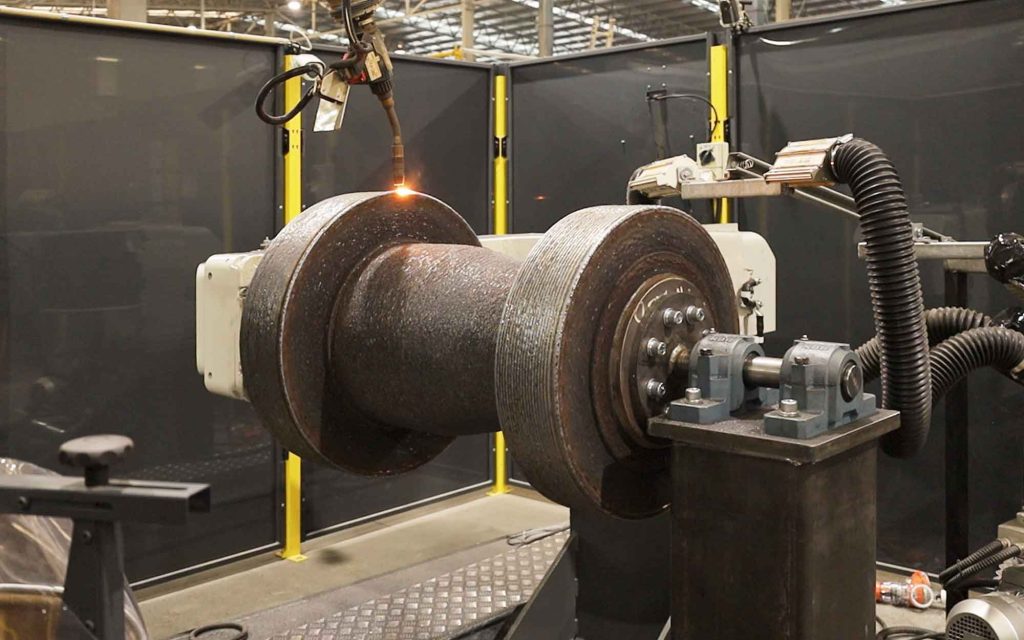
Featured image shows WAM 3D printing in action. Photo via AML3D.